Me and my blog

Follow me on Twitter @emma1hartley
Showing posts with label John Leonard. Show all posts

Thursday, 13 March 2014

Ben Bradshaw MP gets a briefing about the folk awards from Bob Shennan, head of BBC Radio 2, and invites me to write to him


Back in December the head of the culture, media and sport select committee, John Whittingdale MP, approached the BBC to inquire about the anonymous judges of the BBC folk awards. And got a briefing paper.


This month Ben Bradshaw, Labour MP for Exeter and a fellow member of the culture, media and sport select committee, did the same thing. Whereas Whittingdale got his briefing from Andrew Scadding, head of the BBC's public and corporate affairs, Bradshaw received a briefing from Bob Shennan, controller of Radio 2.


Here it is... though if you read Mr Whittingdale's, the similarities may strike you more than the differences. 


"The BBC Radio 2 Folk Awards celebrate outstanding achievements during the previous year within the field of folk music.  The nominees are chosen by a voting Panel which is made up of approximately 190 people.  The Panel is comprised of those persons who have a professional or semi-professional interest in the folk industry, i.e. folk festival and folk club organisers, journalists, presenters, record company personnel, folk music academics, etc.

Folk Music is a small music sub-genre.  Although very few folk artists are attached to major labels some do have record companies of reasonable size, such as Proper, who have large budgets and a marketing team. However, the vast majority of folk artists still run their own small labels and are genuine cottage industries. There is no doubt that within the folk genre there is a great professional boost for people who win a folk award, which although perhaps small compared to a Brit Award or a Mercury win, it is measurable. If the voting panel were published there would be an incentive for the major and better off record companies to lobby the panellists to influence their vote. This would disadvantage many of the smaller, self-releasing nominees who could not afford the cost of this lobbying. Each year the BBC Radio 2 Folk Awards throws up new names that would probably not get such an opportunity if there were to be heavy lobbying from better off artists. 

In its current form the Folk Awards does present a genuine level playing field that could be jeopardised if we change our voting system. The process used is in line with other major award events such as the Brits and is regularly and rigorously examined by BBC compliance and Editorial Policy.

The Awards are determined by two rounds of voting by the wider Panel:

Round One: The Voting Panel are asked to nominate up to 3 artists in each category.  To avoid any possible conflict of interest, panellists are not permitted to nominate artists with whom they have a close professional interest.  Managers, agents, publicists or record company members of staff, are not allowed to vote for any artist(s) that they represent.

Round Two: Each Panellist can vote for one nomination in each category.  Panellists are not permitted to vote for artists with whom they have a close professional interest.  These votes are counted by the BBC & Smooth Operations and the nominee with the most votes in each category is declared the recipient of the award.  Winners are announced on the night of the Folk Awards. Spoiled voting papers (e.g. papers where more than one vote has been cast or where the mark is not clear) will be discounted.  Only the winner with the most votes is recognised, and no other results are released (i.e. there are no runners up).In the event of a tie, that is more than one artist receiving the same highest number of votes, then the award will be made jointly to all the artists. 

The top 5 ‘Best Albums’ nominated in round one are put to a public vote on Radio 2.

The Awards ‘Best Original Song’ and ‘Best Traditional Track’ are awarded by a specialist Panel

The Panel comprises of people with professional or semi-professional interest in the folk industry.  
The Folk Awards Committee nominates and oversees the panel.

The Specialist Panel for 2014 are:
Ian Anderson - Editor, Roots Magazine
Bruce MacGregor - Presenter, Travelling Folk (BBC Scotland)
Frank Hennessy – Presenter Celtic Heartbeat (BBC Radio Wales)
Jon Lewis – Producer Radio 2 Folk Show – Smooth Operations
Karine Polwart – Musician, Song Writer and Previous Award Winner

The Awards for ‘Lifetime Achievement’, Good Tradition’, Lifetime contribution to songwriting’ and Roots Award is determined by two rounds of voting by the Committee:-

The decision is taken at a meeting scheduled towards the end of the 2013.  The Committee have an open discussion of these nominations with a view to arriving at a consensus.  In the event of failure to reach a consensus, the award is decided by way of a vote.  Smooth Operations will keep records of all committee meetings.

The Young Folk Award is determined by a separate panel of judges.  A shortlist of 10 acts is selected from all the entries submitted to the Young Folk Award competition.  These 10 acts are invited to a Performance weekend, which culminates in a performance concert from which a specialist panel of judges, comprising musicians and industry personnel, determine a winner.

Nominated Representatives
The BBC & Smooth Operations appoint nominated representatives that are responsible for monitoring the voting. They will ensure that votes are properly collected and counted and that the process is conducted in line with the rules as well as the BBC's Editorial Guidelines on Awards. Nominated Representatives are not permitted to vote either as part of the Voting Panel or The Folk Awards Committee.  Smooth Operations keep and store all nomination and voting papers on behalf of the BBC for 3 years following each award ceremony.

Nominated Representatives for 2014 are:
Louise Whitehead                   – Project Manager, Smooth Operations
Fergus Dudley                          – Editor, Editorial Standards BBC Radio 2, 6 Music & Asian Network

The Folk Awards Committee consists of 5 people, 2 are members of the Folk Awards production staff, 2 are senior members of BBC Radio 2 staff and the 1 is an independent expert.

The Folk Awards Committee 2014 are:

John Leonard                            – Managing Director, Smooth Operations (Chair)
Kellie While                               – Head of Programmes, Smooth Operations
Mark Simpson                         – Producer Bob Harris Show, BBC Radio 2
Mark Ellen                                 – Music specialist
Al Booth                                      – Specialist Editor BBC Radio 2

Voting Panel - Terms and Conditions
A copy of the ‘Panel Declaration Form’ provided must be signed and returned along with the nominated/voting form, failure to do so will render the nomination/vote void.  By returning a completed nomination/voting form, panel members acknowledge that they are still eligible to be part of the Panel and that they will abide by these rules.

Since its inception in 1999 the BBC Radio 2 Folk Awards has become a significant annual cultural event. It has been responsible for introducing over 400 folk artists from grass roots level, via the Horizon Award and more significantly via the Young Folk Award, to main stream audiences.

This year alone, two of the artists nominated for Folk Singer of the Year, Bella Hardy and Lucy Ward first appeared on Radio 2 as finalists of the Young Folk Award.

Some of our past Horizon Award winners are now listed amongst the most respected folk artists in the world. Karine Polwart, who went on to win Folk Singer of the Year is one of Scotland’s most prominent and respected singer songwriters. Cara Dillon, Julie Fowlis (now co-presenter of the Folk Awards) Blair Dunlop and Kris Drever of the band Lau, are all past Horizon Award winners.

We are very proud that there is such a quantifiable and measureable positive effect on the careers of artists such as these in a genre of music that does not often achieve the mainstream attention it deserves. By looking back over the 15 years of the Radio 2 Folk Awards we can see how many of our fledgling grass roots artists have developed into internationally successful performers."


After receiving the briefing, Ben Bradshaw invited me to address Bob Shennan myself directly, which I have done. Here is the letter.


Dear Mr Shennan,

Ben Bradshaw MP has very kindly offered to pass this message to you on my behalf, in his role as a member of the government's culture, media and sport select committee, as I've been having some trouble wading through the BBC's bureaucracy, in particular the application to yourselves of the Freedom of Information act, which seems in my case to have resulted in the opposite.

He also forwarded the briefing you sent him about the BBC Radio 2 folk awards and its anonymous judges. He's a busy man, though, and therefore is possibly unaware of its similarity to the briefing sent to John Whittingdale MP - the chair of the CMS committee - by Andrew Scadding, head of the BBC's public and corporate affairs.


Also, the similarity that your briefing to him bore to remarks made by John Leonard back in 2011 on the same subject

In fact, the strong similarity that all of these sets of remarks bear to each other is quite surprising and makes me wonder whether they are not, in fact, the same set of remarks recycled?

The most surprising thing of all about this would be that the first time they were made, they were held up to ridicule in the British national media. 


It's hard to imagine why any media organisation, especially a taxpayer funded one like the BBC, would batten down the hatches after that rather than considering the merit of the question: you would think that the organisation's instinct would be to do the opposite. In this instance, the question is "Who are the judges of the BBC Radio 2 folk awards"?

I came at this sideways. I thought it would make an interesting subject for my blog and at first there seemed to be no question of secrecy. I knew a judge, who agreed to do a background interview, Mike Harding, who at the time was the main folk DJ on Radio 2, said the names weren't a secret. But then it turned out they were. And it seemed at the time that they were only because John Leonard - owner of Smooth Operations, who the BBC pays to run the awards for them - said so. Read what he said for yourself.

I'm sure you're aware that the BBC has guidelines for running award ceremonies.


which include that "criteria for judging or nominations must be transparent, clear, fair and consistent". 

Knowing who the judges are falls squarely under this guideline. Moreover I ask: what genuine interest does Radio 2 - or the BBC more widely - have in concealing this information?

The only argument that presents itself - and it has done on three separate occasion now, in John Leonard's off-the-cuff remarks, subsequently in the corporate briefing to John Whittingdale MP and now in your briefing for Ben Bradshaw MP - is that making the names public would result in attempts to influence the judges.

Shall we examine this idea for a moment?

Where else in British public life is this argument taken seriously? Is Radio 2 asking us to believe that if we knew who the judges were this would somehow place someone, somewhere at a disadvantage? How?

Surely this is analogous to arguing that if we knew who our MPs were we might try to influence their policies? Or that if we knew how our taxpayers' money were actually spent we might wish it to be done differently every once in while? 

The only way one can meaningfully influence the outcome of an honest music judging process is by playing a judge some music. And yet this is exactly what these judges are supposed to be doing: listening to as much music as possible. To suggest otherwise is to suggest that the process is a stitch-up and that the judges should be restricting themselves in some way to a particular group of folk musicians, or music produced by a particular set of music producers. Surely this is not what is intended? Is it? It may be worth considering for a moment that the 190 judges are all somehow involved in the industry and the implications of that.

Conversely, if the fear is that the judges themselves are corruptible - that they could be bribed with a signed Seth Lakeman CD or a free felafel at a festival - then it is the job of the administrators to choose someone honest instead. Obviously with 190 judges at the last count, it is hard to know much about any of them... and surely that is another reason to throw some light on the situation? If Smooth Operations and the BBC do not have the time to keep track of these judges, why not let the rest of us have a go? Or have fewer and change them regularly.

Refusing to name the judges of the folk awards is, by a kind analysis, probably a time saving measure. Everyone involved in the awards' administration would rather not change the process: if it aint broke, don't fix it. And yet this argument is the essence of conservatism.

Folk music is the music of the people, who are not always best served by conservative attitudes. What the industry, its musicians and fans deserve is a transparent set of awards, rewarding the hard work and talent of the folk, roots and acoustic musicians of the British Isles and showcasing them internationally. This would go a long way to counterbalance the manufactured top-down nature of reality music shows like Britain's Got Talent, The Voice and The X Factor, that can lead young people to believe that the only route to success is to be picked from obscurity by a celebrity who will wave a magic wand and change their lives forever. Surely better to send the message that hard work, talent, good songwriting and touring are rewarded? 

Some of this country's best exports are cultural. And yet the image we most often present of ourselves abroad - Downton Abbey, Brideshead, The King's Speech - is a very partial view of British society. I believe it is the job of the BBC to showcase the talents of British artists from all walks of life and that one of the ways this may be achieved is by better administering the BBC Radio 2 folk awards.

This year the date chosen by the BBC Radio 2 folk awards administrators for the ceremony was the same night as the Brits. Surely this, if nothing else, should have sent up a red flag somewhere in the BBC's compliance department that there was something awry with the conduct of these awards? What are the folk awards for, if not reaching an audience of music lovers - music lovers who were largely occupied elsewhere on that evening.

Naming the judges of the folk awards would go some way towards assuaging doubts that the BBC is serious about its commitment to this kind of music and that it would like the awards to be properly administered. Mr Shennan, I ask you to name the judges. 

Thank you.

* If you'd like to receive posts from this blog directly into your Facebook newsfeed, you could *like* its Facebook page and then use the drop-down menu to indicate that it's one of your "interests". This will enhance the possibility that you'll get them. You could also follow me on Twitter at @emma1hartley


Thursday, 11 October 2012

Change at the BBC Radio Two Folk Awards

Some of you know that last year I wrote quite a lot about the BBC Radio Two Folk Awards. I hadn't intended to... it just kind of snowballed. 


It started as a mild curiosity about how they're run and ended with an unsuccessful Freedom of Information request for the names of the judges - which are still secret - and the story being followed up in the Guardian and The Independent

If you don't know what I mean and would like to find out, or if you'd like to recap, you can read about it here and follow the links at the bottom from one post to the next.

I'd always intended to do it all again this year if it didn't work the first time (and the names of the judges weren't made public), but this year with variations and a bit more creativity. 

So a couple of weeks ago I wrote some emails and made a start. Then yesterday... 

My phone went. The reception wasn't very good because I was on a number 214 bus heading up the City Road but it turned out that it was Fergus Dudley of the BBC Radio Two compliance department. 

This was curious because I hadn't actually tried to contact him. I'd tried him last year but he'd never returned any of my calls so I'd given up, imagining an empty space behind a desk, perhaps a shirt lying Reggie-Perrin-like nearby.

Yes, he said. I'd emailed him about two and a half weeks ago and he was returning my message. I've since checked and my memory wasn't deceiving me. What had actually happened was that I'd emailed Kelly While at Smooth Operations - the contracted in private company that organises the awards for the BBC (and films the Cambridge festival for Sky, among many other things). 

I'd also rung her twice in two days this week because, having left for it a decent period, it was time to follow up the email.

So my reward was a phone call from Fergus Dudley at the BBC. Since cynicism is useless in these situations, I'm trying to be surprised that the interests of a senior producer from Smooth Operations - who receive public money to make the folk awards for the BBC - and the person employed to hold the company to account find their interests so closely aligned that they forget who's who.

Anyway.

He was returning my call, he said.

Thanks. I was wondering whether the BBC will be making the names of the 170 judges of the folk awards public this year?

No, he said. You see (after a scramble through my bag the notebook was out) there was no need for this because the Brit Awards don't make the names of their judges public. And neither do the Oscars or the Baftas.

None of those three awards ceremonies are run by the BBC on public cash are they, I responded? So they're not subject to the same guidelines about transparency. We moved on.

To begin with it felt like a re-run of a slightly daft conversation I had with John Leonard, who runs Smooth Operations, last year. I suppose it's possible that Dudley had looked at the post I've just linked to - which is about that conversation - before ringing. "If the names of the judges were known," he said, "people would lobby them. And some artists wouldn't have the time or the money to do it."

"But, " I said, feeling trapped in a time warp, "the only way one could meaningfully lobby a folk awards judge would be with a copy of one's music. And sending something from Soundcloud or Bandcamp by email is completely free and it travels along broadband wires at the speed of light." What's next?

"Not everyone is across that technology. It's a small industry," he said, taking my breath away, before adding that he thought it was important that the 170 judges were "specialists in the folk area who have the reputation to make these decisions".

Why? Don't you trust anyone else to recognise good music when they hear it?

"You have to have have people who are involved in the industry."

Why? This means that your judges have a financial interest in the outcome. We got really stuck here. He didn't seem to accept that working in the folk world is the same as having a financial interest in it. 

"I never said these people have to have a financial interest in the industry," he said. It began to feel as if the conversation was unravelling.

"They fill out a form declaring their interests," he continued, apparently unaware that this is not the same thing as making sure that they don't vote for any of their mates' bands. After all, declaring one's interests to person or persons unknown is valueless unless the information can be used to hold the judges to account for their subsequent decisions. And since we don't know who the judges are... Oh! Here we are back at the beginning again. 

And then just when it was all starting to sound terribly, well, terrible...

"But there will be some changes this year."

?!

"We will be taking two of the awards away from the larger panel, to be decided by a smaller panel whose names will be made public. And one of the awards will be decided by a public vote. We are doing this because we'd like to make the awards more acceptable to the wider Radio Two audience."

Blimey. 

"I can't be more specific about who the people on the smaller panel are at the moment. I don't need to tell you that and it hasn't yet been issued as a press release. But we've taken action following your considerable interest last year in the way these awards are run. We have opened it up."

Is this perhaps a prelude to making all of the names of the judges known in the near future? 

"Every two years we review the way the process works. We will be reviewing it again next year and it's possible that we will make this list public. Maybe we will and maybe we won't."

And breathe...

This is good. It's promising. 

However, fobbing people off with a small change after a larger one has been asked for is an age-old tactic.

Some observations.

Large organisations change slowly. I know I wasn't the only person to have raised the issue of the transparency of these awards over the years and don't deserve all the credit for these small changes. I hope they are the beginning of a larger change in the culture of the awards and will result in complete transparency about the judges' names next year. But it's also seems possible that the question of financial interest in the outcome will remain - since Dudley for one doesn't seem to understand that making one's living in any industry is the same as having a financial interest in it and that this, in turn, is a corrupt and conservative force on the awards. There must be other people at the BBC involved in the decision-making process and perhaps they do understand - Dudley wouldn't tell me who he answers to. But I'm guessing that the controller of Radio Two, Bob Shennan, is his line manager.

Secondly, when Dudley told me that what we were talking about was "a small industry" I thought uh-oh. If he thinks the folk awards have been catering only to a small number of people since they started in 2000, that accounts for a lot. The aim should surely be to show off the best of British folk, defined as broadly as possible without making the term meaningless, and promoting it to anyone who takes an interest. And by that I mean the world's music-lovers. The awards should feed people's souls while spreading the word about British folk, which will ultimately benefit everyone involved. And that means promoting fresh takes on old music with as much vigour, creativity and enthusiasm as we can muster. No more Don McLean and his ilk please... for any number of reasons.

This country's creative output is one of its great exports for reasons involving language, culture and history. We should see these awards in that context and be prepared for interest from everywhere. The British folk scene is stuffed with world class musicians who barely make a living and there's just no excuse for it.

Thirdly, the more transparent the folk awards are the better for all concerned. It's to be hoped that scrutiny will mean better communications, the weeding out of any judges who don't leave their homes or use the web, the resulting exposure of  the judges to more and a wider variety of music and that they will not feel able to restrict themselves to voting only for the bands they've seen and heard the most of during the previous year.

There's something in the air. Let's see what it is.

* Read last year's posts about the folk awards starting with this one and following the links at the bottom to the next.

* If you'd like to receive posts from this blog directly into your Facebook news feed you could *like* its Facebook page. Or follow me on Twitter @emma1hartley

Wednesday, 25 January 2012

Freedom of Information Act redefines journalism in Orwellian terms

I've had an email from the Information Commissioner about my request that the names of the judges of the BBC Radio Two Folk Awards be revealed, the request that the BBC's poorly named Freedom of Information office had already denied.


If you recall, the reason why the folk awards was exempt from the Freedom of Information Act, the BBC said, was because obligations under it vanish if the thing under scrutiny can be defined as art, journalism or literature. So the folk awards qualified as either art, journalism or literature. The BBC was a little hazy about which.


On the other hand, there was nothing much that was hazy about the eight page letter from the Information Commissioner, which was full of legal twists and turns: lots of people have challenged the way the FoI Act works in the last five years. But what it boiled down to to in the end was that the law defines the BBC Radio Two Folk Awards as - drum roll - journalism.

Specifically...

... the "second limb of the definition" being journalism.

Just think about that for a moment.

John Leonard's stated reasons for "employing judges anonymously" were that (1) they might get free CDs and (2) too many musicians would try and get in touch with the 150 or so judges (for what else is "lobbying" in the context of the folk awards but playing someone your music? There are no large record companies to offer financial inducements or lavish freebies, whatever Leonard might like to suggest) and that this would place undue pressure on them.

Both of these reasons are ultimately about concealing information. Firstly the names of the judges are concealed so that, secondly, music will be concealed from the judges.

I ask you: what does this have in common with journalism? However hostile one might feel to individual journalists or media outlets, journalism in a democratic society is not about concealment. It is about the opposite.

Something is very wrong here, for the BBC and the Information Commissioner to have arrived at a point where they are defending the concealment of information on the grounds of journalism.

I refer you to the concept of doublethink from George Orwell's novel 1984.


Sorry. Couldn't resist that :-) Some points.

(1) This state of affairs may be partly due to a confusion between journalism and the relatively new concept of "content", which is something else entirely.

(2) Other people will ask the same question of the BBC and the Information Commissioner in the future - in precisely the same way that I have not been the first to take it to them myself. (And thank you, by the way, to the person - let's call you Marjory - who got in touch to say that they'd already trodden this path, and accurately predicted the outcome so far. There may have been others - the data protection act prevents us from knowing.) Anyone reading this blog can pursue the matter in the same way I have and I know that some have considered it. This is because the BBC Radio Two Folk Awards is produced using public money and we have a right to know how it is spent. This money, incidentally, goes into the pockets of John Leonard and all employed by UBC Media Group, lest we forget. Our money.

(3) UBC Media Group is listed on the stock market and check out the correlation between the stories running about the company on this blog and the drop in share price on this graph. Is that a coincidence? It's unlikely, since the story was picked up by Roy Greenslade, whose media column in The Guardian is read by analysts. It's lost more than 20 per cent of its share price since the beginning of December.

(4) I wonder whether Sony was aware of UBC Media Group's approach to preferment when it chose to bestow the Sony Awards on Smooth OperationsWas its decision "in spite of" or "because of"? I think I may ask.

(5) Unless the process of judging the folk awards ceremony is seen to be honest John Leonard, the BBC, Sony, Uncle Tom Cobbly and all might as well give away the awards within their gift to the musicians, agents and PR people who've made them most tempting offer. Because we don't currently know any different.

And yet despite all this, the Information Commissioner has left a chink of light. I asked why the folk awards are different, as far as the BBC was concerned, to the their Sports Personality of the Year award, which not only publishes the provenance of the judges but for whom they voted. And this was the Information Commissioner's reply


So come on the BBC, John Leonard, Smooth Operations and the board of UBC Media Group. Do us the courtesy.

* If you'd like to read this saga from the beginning you could start here.

* Here is the next post about the BBC folk awards.

* If you'd like to receive posts form this blog directly into your Facebook news feed, you can do so by *liking* its Facebook page.

Tuesday, 22 November 2011

The folk awards, a couple of things

The response to my posts yesterday and the day before about the BBC Radio Two Folk Awards has been quite astonishing... It looks as if I put my finger on something that had been troubling a lot of people for a while.


If anyone is interested in getting their voice heard on the subject, they could email the man at the BBC who is supposed to be responsible for making sure that the folk awards and Smooth Operations comply with the BBC's rules about transparency. A good place to start would be to ask him to make sure that the list of judges is made public.

His name is Fergus Dudley and his email address is fergus.dudley@bbc.co.uk He's on Twitter as @FergusDudley, though he appears not to have tweeted for quite some time.

You could also email Smooth Operations to let them know how you feel. I don't have an email address for John Leonard - anyone? - but there is a general one, which is info@smoothoperations.com

And the second thing is that a couple of people have contacted me to say that they are judges for the folk awards and were very happy to see my blog posts. So I was thinking that if there are any other judges out there who'd like to "out" themselves in the name of transparency - since the BBC and Smooth Operations agree that there has never been anything preventing them from doing this - you could email me here and if there is a decent sized handful I could write a separate post about what the folk awards look like from that point of view.

* Read the next post about the BBC folk awards here

* If you'd like to receive posts from this blog directly into your Facebook news feed you could make it so by *liking* its Facebook page.

Monday, 21 November 2011

Smooth Operations and the BBC defend the folk awards

I had a phone call from John Leonard (below), who runs Smooth Operations and therefore the BBC Radio Two Folk Awards, about yesterday's blog.


His starting point was that he didn't want the names of the judges to be public. "I'm very aware about the better off record companies being able to lobby people on the panel," he said.

Which ones, I asked? I know Seth Lakeman was with EMI but isn't any more as he's struck out on his own. So which large record companies have a foot in the folk scene at the moment?

"I couldn't possibly say which ones," he replied, before mentioning Topic and Proper. However, he later changed his mind about these companies, suggesting that I was putting words into his mouth. I had raised the way in which Topic and Proper seem already to do quite well out of the folk awards, and asked how their influence would increase if the names of the judges were on the record? He wasn't sure but seemed very certain that the forces of capital would do something bad to the judges if their names were to be made public.

He added that another downside of judges making themselves known would be that they might use their position to get free CDs.

There is a list, he explained, of new music sent out to all the judges every year, based on what's been played on the Mike Harding Show (which is also produced by Smooth Operations). I mentioned a comment that was posted under yesterday's blog, from Marjory Carlisle, about two friends of hers who are judges for the folk awards but who, as far as Marjory could see, don't seem to get out and about much. "If they listen to the Mike Harding Show they will hear most things," he said. Then he changed his mind, saying within seconds that "the Mike Harding Show scratches the surface of the folk scene". He also explained that in order to have one's position as a judge rescinded one has to have not filled in the form the previous year.

Discussing the extent to which the relationships between the judges and the nominees are transparent, he emphasised the form that has to be signed every year by the judges, saying that they will not vote for musicians with whom they have a working relationship. But wouldn't it be better, I asked, if the judges - perhaps a different group of people less well-connected in the folk scene - could simply vote for the best contenders?

"I used to think that," he said. "But I was persuaded that I was wrong," adding that this was related to BBC compliance.

In terms of how one is to make a name for oneself on the folk scene, he says that he started out on the folk club circuit when he was 19 and thought it should probably still be done the same way. "I just went around all of these clubs. It's up to a you to get to know all the folk journalists but the first job of a young band is to get themselves a promoter." He named Alan Bearman and Adastra as possibles, adding that "there's one in Scotland".

He also said that he doubted that a young band was entitled to consideration on its merits until it has paid its dues. "If a band is just starting out do you think they are seriously eligible for a folk award?" he asked. Not unless they're really good, I replied. But it would also be good if the structure of the industry and its marketing were transparent enough for them to be able to make their way. Especially since the internet has turned the music industry on its head.

We returned to the idea that only someone wealthy would be able to lobby 170 people, as if it would be expensive. I thought (a) he may not have heard of burning CDs or sound cloud and (b) if your career is at stake you invest in it. This may be a thought that only someone who's had to pay back student loans would take seriously though.

I asked whether he'd heard of a terrific live folk band called The Destroyers. "Why haven't they sent us their album?" he asked. I was really quite surprised. "Perhaps they didn't know who to send it to?" I offered.


They may have done, as far as I know, but they play mainly in cities - not folk clubs - and there is no sign of any kind of management on their website, so they may not be on his radar even though they've been around for five years.

Earlier in the day I'd been sent a link to this page on the BBC website relating to compliance when running BBC awards ceremonies. It makes interesting reading, especially the parts about transparency (near the top) and, section three, about the judging: "The judging system should normally be clearly explained to the audience and must be explained to entrants via on-air/online announcement and the terms and conditions."

There is also a mention of a senior editorial figure who is responsible for making sure that these rules are applied. In the case of the BBC Radio two Folk Awards, this is Fergus Dudley.


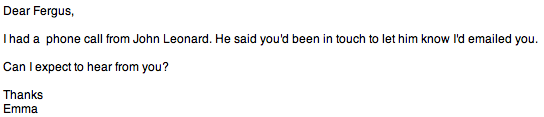
If you double click on that it should become legible. I heard from John Leonard first, who said he'd heard from Dudley that I'd been in touch with him too. So I tried again.


* Read the next post about the BBC folk awards

* If you'd like to receive updates from this blog directly into your Facebook news feed, you could *like* its Facebook page. Or follow me on Twitter @emma1hartley

Emma Hartley blog logo

24hourlondon logo

Did David Hasselhoff End the Cold War?