Me and my blog

Follow me on Twitter @emma1hartley
Showing posts with label Fergus Dudley. Show all posts

Friday, 28 March 2014

BBC bigwig Bob Shennan argues that secrecy shields the BBC from corruption

So where have I got to, seeking the names of the judges of the BBC Radio 2 folk awards? A quick recap... 


Back in 2011, wondering why so many folkies seemed to find the folk awards so hard to like - though not me at the time - I asked who ran the awards? Specifically, I asked who the judges were and it turned out that their names  were a secret.

Partly because my undergraduate degree was in politics (at Leeds) and a large part of that four-year course was spent on democratic theory, I knew without a shadow of a doubt that this was not the way an organisation funded by public money in a parliamentary democracy was supposed to conduct itself. Moreover, someone helpfully sent me a link to the page on the BBC's website where it makes a commitment to transparency for its award ceremonies.

So I put in a Freedom of Information request

That was a waste of time.

The Information Commissioner denied my request because anything the BBC does, including an awards ceremony, is "journalism" as far as he is rather lazily concerned. I found this particularly irritating as I've been a journalist at UK national newspapers for over 15 years and the Information Commissioner had basically picked a large publicly funded but essentially inanimate body over me as the more significant "journalist" in this situation. That mechanism is broken and everyone involved in it should be ashamed of themselves.

In October 2012 something that looked like a breakthrough happened. I got a call from a BBC employee called Fergus Dudley, who I can say from experience only answers his phone calls and emails when his bosses tell him to, saying that the BBC Radio 2 folk awards would be flinging open the windows and allowing a little light in to proceedings. A little of the voting would be done by the public that year and there would be a special panel of people who would choose the winners of a couple of the awards, whose names would be known. He also hinted that there might very possibly be bigger changes on the horizon.

But that turned out to be untrue. Like a previous attempt to co-opt me by inviting me to join the 190-strong judging panel - all of whom are financially involved in the UK folk industry, it has emerged since 2011 - it was a ruse, spun in the hope that I would shut up. 

That's not really me though.

Early last year I wrote a piece for the Spectator  about why having a properly run folk awards is important. It's political: UK plc markets itself internationally as Downton Abbey, The King's Speech and Hugh floppy-haired Grant. But there is more to us than our ruling class.

There is a folk revival taking place on an unprecedented scale internationally, but the BBC folk awards is still apparently most interested in the one that took place in the 1970s and its definition of folk has not really moved on. Hence the ever-growing number of lifetime achievement awards it gives away.

But there is an entire industry of singer-songwriters playing traditional instruments, knowing some of the older songs, touring assiduously and yet struggling to make a living because the biggest marketing platform they have is used primarily as a force for promoting those who took part in the last folk revival and those who resemble them, rather than those working in its most recent incarnation. In these days in which television encourages the young to believe that musical success is handed out like sweeties by Simon Cowell and Tom Jones, the UK should instead be treasuring its hardworking, touring musicians who are keeping music live. Aren't the values involved in that important?


So towards the end of 2013 I wrote to John Whittingdale MP, chairman of the government's Culture, Media and Sport committee, asking whether it would be possible to look behind the curtain of secrecy and filch the list of the 190 judges names? Instead he received this waffly briefing.


Then Ben Bradshaw, Labour MP for Exeter and a member of the CMS committee who was recommended to me as being an "activist", had a go and received the same briefing as John Whittingdale, from a different person.

No list of judges was forthcoming. The BBC had closed ranks against its own parliamentary oversight committee.

Ben Bradshaw - apparently unshocked by this - put me in touch with Bob Shennan (above), the head of Radio 2, 6 Music and the BBC Asian Network directly. Mr Shennan responded to my letter to him - in the link above - like this.


It's very small lettering there, I know, though you can make it bigger by clicking on it. The first seven paragraphs are a repetition of sections of the waffly briefing paper delivered to the two MPs. The eighth, unrelatedly, says

"With these things in mind I believe that releasing the names of the judging panel would compromise the impartiality of the voting process."

This is the nub of the BBC's argument for not releasing the names: the names of the folk awards judges are a secret because making the information public would "compromise the impartiality of the voting process".

I wrote back.

Dear Mr Shennan.

Thanks for the message below. Could you be a bit more specific please about the ways in which "releasing the names of the judging panel would compromise the impartiality of the voting process"?

I look forward to receiving your reply.

Best wishes
Emma Hartley

He replied


Dear Miss Hartley,

I guess it is simply a question of lobbying and undue pressure being brought to bear on judges to support certain acts. That would be likely to effect (sic) the impartiality of the voting.

Best
Bob

Sent from my iPhone


I wrote back pointing out that the only way one can meaningfully lobby a music awards' judge is by playing them some music, unless they are corrupt. If the former is the case: what's the problem? Listening to music is what judging is all about. And if they are corrupt, get some new judges. Making the list of names public would help purge any corruption. I also quoted him some Jeremy Bentham and Woodrow Wilson on the subject of corruption and secrecy in public life. But he didn't seem to like that very much and the next thing I knew there was an email from Fergus Dudley...

Unless one is cynically assuming at this point that the folk awards are a way of lining the pockets of the judges - could this really be true? - it is almost inconceivable that the BBC would devote this much time and effort to concealing these names: the Freedom of Information act, the Culture, Media and Sport committee and several BBC executives have all given their expensive time to the issue now. What kind of a use is this of public money? 

Moreover, this kind of nonsense is an engine for making people cynical about the BBC.


To conclude, here is a word from Genevieve Tudor, that least cynical of BBC employees and one of the small number of folk awards judges whose names have been made public as a result of the changes two years ago. Genevieve is a BBC presenter of a folk show in Shropshire and surrounding counties and was involved in choosing the Best Original Song and Best Traditional Track winners this year and last. This is me instant chatting her on Facebook.


So I guess that's that argument disposed of... Folk awards judges whose names are public are not subject to undue pressure or lobbying of any kind. This was the reason given for keeping them secret: can I have the names of the folk awards judges now? 


If anyone at the BBC or Smooth Operations would like to send me the judges' names you can contact me here.

Or if any of this strikes you as ridiculous, you can contact Bob Shennan in person at the BBC on bob.shennan@bbc.co.uk


* If you'd like to receive posts from this blog directly into your Facebook newsfeed, you could *like* its Facebook page and then use the drop-down menu to indicate that it's one of your "interests". This will enhance the possibility that you'll get them. You could also follow me on Twitter at @emma1hartley

Thursday, 22 November 2012

Fantasy folk awards 2013

After a perusal of the folk awards nominations pages on the BBC website it's a treat to discover that the corporation has done exactly what it said it was going to do when Fergus Dudley contacted me - and named the panel of judges who will be deciding two of the awards.  


I look forward to hearing what manner of expensive inducements Genevieve Tudor and the rest will be (wo)manfully resisting in the name of impartiality. In fact, after all the curmudgeonly talk of how naming the judges will corrupt the process I'd be disappointed if their usually level heads haven't been completely turned by February.  

Here's a scene I may have imagined.

ME: (At the folk awards in Glasgow, waving one arm in the air while trying to bat Seth Lakeman away with the other using a programme): "Genevieve! You look well! You're all aglow. Have you been away?"

GENEVIEVE TUDOR (looking around, slightly panicked, for an escape route but seeing only half-pissed folkies in Show of Hands jerkins blocking her way at every turn) "Darling! How lovely to see you! (She's faking) Yes. Er. I've been away."

ME: "Wow. Where've you been? That's a pretty tan."

GENEVIEVE: "Oh, you know. Around...."

Pause.

GENEVIEVE: (Crumpling visibly) "Oh god. I can't bear it. The shame of the thing, I mean." (Tugging at her flaming tresses distractedly.) I thought I'd be OK but... I'm sorry. 

ME: (Concerned) Oh dear. What is it? Are you OK?

G: It's those devils from Proper. 

ME: (Sharp intake of breath)

G: (Determined to get it out now) I told them I didn't care about any of it but they wouldn't listen... It started simply enough with the limited edition of Broadside, hand-pressed by Rachael McShane and her groupies during the same ouija board session that produced the album. (Genevieve's biting her fist.)  Judging from the shimmer I think they made it using polycarbonate scraps left over from from Paul Sartin's wardrobe of Barbarella onesies. But I didn't *mind* that. I don't even mind the music. But then they started in with the unsolicited gifts. First it was an entire Welsh dresser full of diamond-dusted mead tankards and the barrels of oak-aged Hobgoblin from Chris Wood's subterranean vaults on the Riviera. And then...

ME: (Appalled) What? What happened next?

G: (Desolate now) Before I knew it they'd whisked me off to Alan Bearman's faux renaissance castle in Antigua staffed mainly by superannuated members of The Mediaeval Baebes. And I was lying by his infinity pool - you know, the one with the tiny little fishes to nibble off the hard skin on your feet, like at Bristol last year - and being fed these teeny tiny cornish pasties by Sam Lee and an entire phallanx of young men dressed as bare-chested angels. 

ME: (Caught between horror and sympathy) Oh God, no! 

G: And then I knew...

ME: (Caught up) What? What did you know?

G: It's going to have to be a lifetime achievement award for Roy Harper this year.

ME: Oh Genevieve! How could you?

(Wailing, fade to blackout)

Let's hope they name all of the judges next time, not just a small panel of five.

* No Radio Shropshire presenters were harmed during the making of this post.

* If this post makes very little sense to you, here's some background.

* And here's a link to a piece about the 2013 awards that was published by The Spectator.

* If you'd like to receive posts from this blog directly into your Facebook newsfeed, you could *like* its Facebook page and then use the drop-down menu to indicate that it's one of your "interests". This will enhance the possibility that you'll get them. You could also follow me on Twitter @emma1hartley

Thursday, 11 October 2012

Change at the BBC Radio Two Folk Awards

Some of you know that last year I wrote quite a lot about the BBC Radio Two Folk Awards. I hadn't intended to... it just kind of snowballed. 


It started as a mild curiosity about how they're run and ended with an unsuccessful Freedom of Information request for the names of the judges - which are still secret - and the story being followed up in the Guardian and The Independent

If you don't know what I mean and would like to find out, or if you'd like to recap, you can read about it here and follow the links at the bottom from one post to the next.

I'd always intended to do it all again this year if it didn't work the first time (and the names of the judges weren't made public), but this year with variations and a bit more creativity. 

So a couple of weeks ago I wrote some emails and made a start. Then yesterday... 

My phone went. The reception wasn't very good because I was on a number 214 bus heading up the City Road but it turned out that it was Fergus Dudley of the BBC Radio Two compliance department. 

This was curious because I hadn't actually tried to contact him. I'd tried him last year but he'd never returned any of my calls so I'd given up, imagining an empty space behind a desk, perhaps a shirt lying Reggie-Perrin-like nearby.

Yes, he said. I'd emailed him about two and a half weeks ago and he was returning my message. I've since checked and my memory wasn't deceiving me. What had actually happened was that I'd emailed Kelly While at Smooth Operations - the contracted in private company that organises the awards for the BBC (and films the Cambridge festival for Sky, among many other things). 

I'd also rung her twice in two days this week because, having left for it a decent period, it was time to follow up the email.

So my reward was a phone call from Fergus Dudley at the BBC. Since cynicism is useless in these situations, I'm trying to be surprised that the interests of a senior producer from Smooth Operations - who receive public money to make the folk awards for the BBC - and the person employed to hold the company to account find their interests so closely aligned that they forget who's who.

Anyway.

He was returning my call, he said.

Thanks. I was wondering whether the BBC will be making the names of the 170 judges of the folk awards public this year?

No, he said. You see (after a scramble through my bag the notebook was out) there was no need for this because the Brit Awards don't make the names of their judges public. And neither do the Oscars or the Baftas.

None of those three awards ceremonies are run by the BBC on public cash are they, I responded? So they're not subject to the same guidelines about transparency. We moved on.

To begin with it felt like a re-run of a slightly daft conversation I had with John Leonard, who runs Smooth Operations, last year. I suppose it's possible that Dudley had looked at the post I've just linked to - which is about that conversation - before ringing. "If the names of the judges were known," he said, "people would lobby them. And some artists wouldn't have the time or the money to do it."

"But, " I said, feeling trapped in a time warp, "the only way one could meaningfully lobby a folk awards judge would be with a copy of one's music. And sending something from Soundcloud or Bandcamp by email is completely free and it travels along broadband wires at the speed of light." What's next?

"Not everyone is across that technology. It's a small industry," he said, taking my breath away, before adding that he thought it was important that the 170 judges were "specialists in the folk area who have the reputation to make these decisions".

Why? Don't you trust anyone else to recognise good music when they hear it?

"You have to have have people who are involved in the industry."

Why? This means that your judges have a financial interest in the outcome. We got really stuck here. He didn't seem to accept that working in the folk world is the same as having a financial interest in it. 

"I never said these people have to have a financial interest in the industry," he said. It began to feel as if the conversation was unravelling.

"They fill out a form declaring their interests," he continued, apparently unaware that this is not the same thing as making sure that they don't vote for any of their mates' bands. After all, declaring one's interests to person or persons unknown is valueless unless the information can be used to hold the judges to account for their subsequent decisions. And since we don't know who the judges are... Oh! Here we are back at the beginning again. 

And then just when it was all starting to sound terribly, well, terrible...

"But there will be some changes this year."

?!

"We will be taking two of the awards away from the larger panel, to be decided by a smaller panel whose names will be made public. And one of the awards will be decided by a public vote. We are doing this because we'd like to make the awards more acceptable to the wider Radio Two audience."

Blimey. 

"I can't be more specific about who the people on the smaller panel are at the moment. I don't need to tell you that and it hasn't yet been issued as a press release. But we've taken action following your considerable interest last year in the way these awards are run. We have opened it up."

Is this perhaps a prelude to making all of the names of the judges known in the near future? 

"Every two years we review the way the process works. We will be reviewing it again next year and it's possible that we will make this list public. Maybe we will and maybe we won't."

And breathe...

This is good. It's promising. 

However, fobbing people off with a small change after a larger one has been asked for is an age-old tactic.

Some observations.

Large organisations change slowly. I know I wasn't the only person to have raised the issue of the transparency of these awards over the years and don't deserve all the credit for these small changes. I hope they are the beginning of a larger change in the culture of the awards and will result in complete transparency about the judges' names next year. But it's also seems possible that the question of financial interest in the outcome will remain - since Dudley for one doesn't seem to understand that making one's living in any industry is the same as having a financial interest in it and that this, in turn, is a corrupt and conservative force on the awards. There must be other people at the BBC involved in the decision-making process and perhaps they do understand - Dudley wouldn't tell me who he answers to. But I'm guessing that the controller of Radio Two, Bob Shennan, is his line manager.

Secondly, when Dudley told me that what we were talking about was "a small industry" I thought uh-oh. If he thinks the folk awards have been catering only to a small number of people since they started in 2000, that accounts for a lot. The aim should surely be to show off the best of British folk, defined as broadly as possible without making the term meaningless, and promoting it to anyone who takes an interest. And by that I mean the world's music-lovers. The awards should feed people's souls while spreading the word about British folk, which will ultimately benefit everyone involved. And that means promoting fresh takes on old music with as much vigour, creativity and enthusiasm as we can muster. No more Don McLean and his ilk please... for any number of reasons.

This country's creative output is one of its great exports for reasons involving language, culture and history. We should see these awards in that context and be prepared for interest from everywhere. The British folk scene is stuffed with world class musicians who barely make a living and there's just no excuse for it.

Thirdly, the more transparent the folk awards are the better for all concerned. It's to be hoped that scrutiny will mean better communications, the weeding out of any judges who don't leave their homes or use the web, the resulting exposure of  the judges to more and a wider variety of music and that they will not feel able to restrict themselves to voting only for the bands they've seen and heard the most of during the previous year.

There's something in the air. Let's see what it is.

* Read last year's posts about the folk awards starting with this one and following the links at the bottom to the next.

* If you'd like to receive posts from this blog directly into your Facebook news feed you could *like* its Facebook page. Or follow me on Twitter @emma1hartley

Friday, 25 November 2011

The BBC folk awards and a freedom of information request

The story so far...

After the announcement of the nominees for next year's folk awards, I was wondering why the identities of the judges are not publicly known and wrote a blog post about it.


I thought there might be some interest in this - everyone loves a mystery - but wasn't really prepared for how much.

The level of curiosity from folkies was especially thought-provoking because everyone involved in running the awards said that the names of the judges are not in any way intended to be a secret.

So I asked for a list.

In particular I asked for a list from John Leonard at Smooth Operations and from Fergus Dudley at the BBC, whose job it is to oversee the contracted-in services of Smooth Operations, which is part of UBC Media. And I was surprised at how complicated the request appeared to be to those most directly concerned. The implication was that instead of shining a light on the awards it would open a can of worms.

Interesting, eh?

So I wrote something else, inviting folkies - or anyone really - to make a practical contribution to the inquiry if they wanted to, reasoning that it would be useful to demonstrate to the BBC and Smooth Operations that I wasn't some lone online lunatic hell-bent on, you know, finding stuff out. Thanks to everyone who bothered to email Fergus Dudley, among others, to let him know you were watching and interested. He's at fergus.dudley@bbc.co.uk if you'd still like to get in touch.

So far I haven't managed to find the whole list of names, although there's been a steady trickle of people ringing and emailing to say that they're judges, wondering whether I'd like to talk to them about it and being encouraging.

In fact, it's been a brilliant week from that point of view. The 15-20 people who got in touch directly all suggested that there were a great many more who'd be interested in the outcome. Phil Widdows over at Folkcast wrote a great open email on the subject to Mike Harding, who presents Smooth Operations' folk show, which I urge you to read. And in response Harding started his own blog, which can only be a good thing.

So, what to do next?

I know, I know... If only there were some way of getting hold of information that everyone says is intended to be in the public domain but isn't. Some mechanism intended to hold institutions paid for by public money to account.

Oh.

Fortunately, the Freedom of Information Act 2000 exists exactly for situations like this. So this morning I asked the Freedom of Information department at the BBC whether it would be able to tell me who the judges of the BBC Radio Two Folk Awards are by supplying a list.


While I was writing this post about it I received a formulaic reply from the BBC


So there you go. With any luck there'll be an answer within 20 working days, which is four weeks. It's no big deal, the world will not end: the BBC actually has a department for this.

So I ask Fergus Dudley, John Leonard and everyone else who's been weirdly fearful about what happens next: what's the big deal?

This is how it's supposed to work.

* Next post about the folk awards

* If you'd be interested in receiving posts from this blog directly into your Facebook news feed,  you could *like* its Facebook page.

Tuesday, 22 November 2011

The folk awards, a couple of things

The response to my posts yesterday and the day before about the BBC Radio Two Folk Awards has been quite astonishing... It looks as if I put my finger on something that had been troubling a lot of people for a while.


If anyone is interested in getting their voice heard on the subject, they could email the man at the BBC who is supposed to be responsible for making sure that the folk awards and Smooth Operations comply with the BBC's rules about transparency. A good place to start would be to ask him to make sure that the list of judges is made public.

His name is Fergus Dudley and his email address is fergus.dudley@bbc.co.uk He's on Twitter as @FergusDudley, though he appears not to have tweeted for quite some time.

You could also email Smooth Operations to let them know how you feel. I don't have an email address for John Leonard - anyone? - but there is a general one, which is info@smoothoperations.com

And the second thing is that a couple of people have contacted me to say that they are judges for the folk awards and were very happy to see my blog posts. So I was thinking that if there are any other judges out there who'd like to "out" themselves in the name of transparency - since the BBC and Smooth Operations agree that there has never been anything preventing them from doing this - you could email me here and if there is a decent sized handful I could write a separate post about what the folk awards look like from that point of view.

* Read the next post about the BBC folk awards here

* If you'd like to receive posts from this blog directly into your Facebook news feed you could make it so by *liking* its Facebook page.

Monday, 21 November 2011

Smooth Operations and the BBC defend the folk awards

I had a phone call from John Leonard (below), who runs Smooth Operations and therefore the BBC Radio Two Folk Awards, about yesterday's blog.


His starting point was that he didn't want the names of the judges to be public. "I'm very aware about the better off record companies being able to lobby people on the panel," he said.

Which ones, I asked? I know Seth Lakeman was with EMI but isn't any more as he's struck out on his own. So which large record companies have a foot in the folk scene at the moment?

"I couldn't possibly say which ones," he replied, before mentioning Topic and Proper. However, he later changed his mind about these companies, suggesting that I was putting words into his mouth. I had raised the way in which Topic and Proper seem already to do quite well out of the folk awards, and asked how their influence would increase if the names of the judges were on the record? He wasn't sure but seemed very certain that the forces of capital would do something bad to the judges if their names were to be made public.

He added that another downside of judges making themselves known would be that they might use their position to get free CDs.

There is a list, he explained, of new music sent out to all the judges every year, based on what's been played on the Mike Harding Show (which is also produced by Smooth Operations). I mentioned a comment that was posted under yesterday's blog, from Marjory Carlisle, about two friends of hers who are judges for the folk awards but who, as far as Marjory could see, don't seem to get out and about much. "If they listen to the Mike Harding Show they will hear most things," he said. Then he changed his mind, saying within seconds that "the Mike Harding Show scratches the surface of the folk scene". He also explained that in order to have one's position as a judge rescinded one has to have not filled in the form the previous year.

Discussing the extent to which the relationships between the judges and the nominees are transparent, he emphasised the form that has to be signed every year by the judges, saying that they will not vote for musicians with whom they have a working relationship. But wouldn't it be better, I asked, if the judges - perhaps a different group of people less well-connected in the folk scene - could simply vote for the best contenders?

"I used to think that," he said. "But I was persuaded that I was wrong," adding that this was related to BBC compliance.

In terms of how one is to make a name for oneself on the folk scene, he says that he started out on the folk club circuit when he was 19 and thought it should probably still be done the same way. "I just went around all of these clubs. It's up to a you to get to know all the folk journalists but the first job of a young band is to get themselves a promoter." He named Alan Bearman and Adastra as possibles, adding that "there's one in Scotland".

He also said that he doubted that a young band was entitled to consideration on its merits until it has paid its dues. "If a band is just starting out do you think they are seriously eligible for a folk award?" he asked. Not unless they're really good, I replied. But it would also be good if the structure of the industry and its marketing were transparent enough for them to be able to make their way. Especially since the internet has turned the music industry on its head.

We returned to the idea that only someone wealthy would be able to lobby 170 people, as if it would be expensive. I thought (a) he may not have heard of burning CDs or sound cloud and (b) if your career is at stake you invest in it. This may be a thought that only someone who's had to pay back student loans would take seriously though.

I asked whether he'd heard of a terrific live folk band called The Destroyers. "Why haven't they sent us their album?" he asked. I was really quite surprised. "Perhaps they didn't know who to send it to?" I offered.


They may have done, as far as I know, but they play mainly in cities - not folk clubs - and there is no sign of any kind of management on their website, so they may not be on his radar even though they've been around for five years.

Earlier in the day I'd been sent a link to this page on the BBC website relating to compliance when running BBC awards ceremonies. It makes interesting reading, especially the parts about transparency (near the top) and, section three, about the judging: "The judging system should normally be clearly explained to the audience and must be explained to entrants via on-air/online announcement and the terms and conditions."

There is also a mention of a senior editorial figure who is responsible for making sure that these rules are applied. In the case of the BBC Radio two Folk Awards, this is Fergus Dudley.


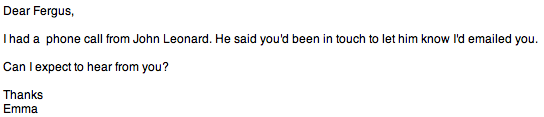
If you double click on that it should become legible. I heard from John Leonard first, who said he'd heard from Dudley that I'd been in touch with him too. So I tried again.


* Read the next post about the BBC folk awards

* If you'd like to receive updates from this blog directly into your Facebook news feed, you could *like* its Facebook page. Or follow me on Twitter @emma1hartley

Emma Hartley blog logo

24hourlondon logo

Did David Hasselhoff End the Cold War?