Me and my blog

Follow me on Twitter @emma1hartley
Showing posts with label BBC Radio Two Folk Awards. Show all posts

Wednesday, 11 December 2013

Letter to John Whittingdale MP, chairman of the culture, media & sport select committee, about the BBC Radio 2 folk awards and its anonymous judges

Dear Mr Whittingdale, 

Lovely to meet you last night: I'm so sorry I couldn't stay for dinner. 


As I said, I'm a professional journalist - presently at the Guardian as a sub-editor, formerly at the Telegraph as an associate editor - who writes a music blog.

http://theglamourcave.blogspot.co.uk/

Two years ago I met someone who was a judge for the BBC folk awards and, thinking this might be interesting as there is usually a chorus of moaning about the nominees (the same names seem to come up every year, is the gist of it), did an off-the-record interview with them about it. The reason the interview was off the record was that the judge I met was under the impression that the names of the awards' judges were supposed to be a secret. There was some confusion around this. Mike Harding, who presented the BBC Radio 2 folk show at the time, said the names weren't a secret. 

http://theglamourcave.blogspot.com/2011/11/bbc-folk-awards-raising-blood-pressure.html

But then John Leonard, who runs Smooth Operations, the production company that produces the folk show and the folk awards for the BBC, waded in and not only said that, yes, they were a secret, but also came up with an elaborate justification for this.

http://theglamourcave.blogspot.co.uk/2011/11/smooth-operations-and-bbc-compliance-on.html

It turned out that the BBC has guidelines for running awards that specify transparency as one of the criteria

http://www.bbc.co.uk/editorialguidelines/page/guidance-interactivity-awards

so I submitted a freedom of information request to the relevant department at the BBC 

http://theglamourcave.blogspot.co.uk/2011/12/freedom-of-information-request-for.html

only to be told that the request for the names of the judges had been denied because the BBC folk awards are "journalism" and therefore excluded from submitting to FoI rules. Since I'm the journalist in this scenario, that was ridiculous. It made me wonder why go to all this trouble instead of simply supplying the names? By this stage there was so much interest that one would assume it would simply have been easier to supply the names.

Roy Greenslade at the Guardian had picked up the story

http://www.theguardian.com/media/greenslade/2011/dec/13/radio-2-awards-and-prizes

as did The Independent

http://www.independent.co.uk/arts-entertainment/tv/news/could-it-all-be-a-fiddle-folk-stars-tell-the-bbc-to-reveal-who-judges-awards-6358939.html

But nothing occurred until the next year, when a month or so before the nominations were announced I received a phone call from Fergus Dudley, head of compliance at Radio 2, saying that there were going to be some changes to the folk awards to make them more transparent

http://theglamourcave.blogspot.co.uk/2012/10/change-at-bbc-radio-two-folk-awards.html

I was invited by Fraser Nelson at the Spectator to write a piece at this stage about why it was important

http://blogs.spectator.co.uk/coffeehouse/2013/01/bbc-radio-2-folk-awards-bottom-of-the-class/

And that was basically where it lay until this year, when the awards nominations were announced in November and it became clear that Dudley's hints and suggestions about naming the judges this year were only that, and had apparently been designed to get me off his back. In response to my inquiries directly to Fergus Dudley and John Leonard I got an email from a junior press officer who was unaware of the history of the request.

This all sounds a bit specific and of interest only to folkies. But the BBC Radio 2 folk awards is the best marketing platform the UK acoustic and roots music industry has, although it does not appear to see itself in this way. There are, I understand, over 180 anonymous judges for these awards, all of whom by Smooth Operations' own admission, have a financial stake in the industry. This is the qualification for the job and many of them know each other. In fact they are laughingly referred to as the "folk mafia" (see my latest post, an interview with Maddy Prior of Steeleye Span, for an example of this). When I started writing about the awards the first thing John Leonard did was try to co-opt me by inviting me to become a judge. 

Mumford & Sons are the biggest band in the world right now and to the rest of the world they are an English folk band. But no other English folk bands have benefited from this surge in international interest, despite there being a folk scene in the UK that is full to overflowing with young talent struggling to get by, because the industry's biggest marketing platform - the BBC Radio 2 folk awards - has never invited Mumford & Sons to take part, nor have they ever nominated them for an award for reasons explored in the Spectator piece. Instead, and despite a constant throughput of new young bands that need a boost in a difficult environment, the same bands run by the same handful of middle men and women get nominated every year, as if folk were a niche thing. Indeed, John Leonard argues that it is, which in his case is self-fulfilling. For instance, Laura Marling has had three unsuccessful Mercury nominations now, as if she were the only young British folk musician the industry-wide Mercury judges have heard of.

Here is a link to a recent More 4 documentary about the groundswell going on in the British folk industry saying many of the same things I'm saying here: I had nothing to do with its production. It is also worth noting that the documentary is one of the few pieces of TV folk output in this country that has had nothing to do with Smooth Operations, which also does much of the folk festival coverage for Sky. 


This is a British industry crying out for the kind of help that the BBC is ideally suited to provide, indeed is supposed to be providing. But instead the BBC runs the awards as if they were a club for John Leonard's mates from the folk clubs of the 60s and 70s adding ever more "lifetime achievement awards" each year. These clubs are no longer relevant to a young generation of musicians financially crippled by college debt who can't afford to go touring up and down the country's folk clubs, which are - it often seems - entirely populated by people who are themselves in their 60s and 70s: this is not ageism, they are simply a very small section of the music-buying, gig-going public. John Leonard, it seems to me, is confused about folk clubs' relevance these days. Young musicians rely on the web for marketing when they are starting out, as every other industry does, but there's no indication from the awards nominations that the judges are even aware of the web, focusing on bands that have been around for four years or longer. There is a separate section for "young" musicians, which does little justice to the breadth and scope of what's out there.

Britain's creative industries are one of its great exports, I believe that the UK market is simply too small to support the amount of folk, roots and acoustic talent we have on these shores and that the BBC institutionally is not pulling its weight in this regard. I also think that if they named the judges of the folk awards, as Fergus Dudley (head of radio 2 compliance) suggested they would before doing a U-turn, we would see why the awards nominees are pulled from such a shallow pool of talent. (I have been told that there are judges on the list who haven't left their own homes for months, relying entirely on the Mark Radcliffe Radio 2 show for their information about what's new.) The fact that this has not been done, moreover, suggests that the BBC knows it has something to hide.

My campaigning on this issue has received an enormous amount of support from folk music fans and musicians, which is evident from the comments on the blogs, as well as emails and personal messages of support when I'm out and about. In particular Phil Widdows at Folk Cast has also campaigned on this.

I would be enormously grateful if you were able to pass this to the people at the committee who regularly deal with the BBC, to see if anything can be done: if any questions could be asked of Fergus Dudley about his intransigence on a matter that seems so cut and dried even by the standards of the BBC's own guidelines? I believe naming the folk awards judges would eventually have a knock-on effect for the music industry in this country that would be wildly disproportionate to the effort involved.

I also believe that the BBC's FoI office is "broken" and would be grateful if you could add my evidence to anything similar you have on the same subject.

All best wishes
Emma Hartley

* If anyone else would like to email John Whittingdale, to add support to my email, you can reach him at john.whittingdale.mp@parliament.uk This is a constituency office email address, but if you label the email "BBC folk awards, anonymous judging" it should reach the staff who deal with his duties as chairman of the culture, media and sport select committee.

* If you'd like to receive posts from this blog directly into your Facebook newsfeed, you could *like* its Facebook page and then use the drop-down menu to indicate that it's one of your "interests". This will enhance the possibility that you'll get them. You could also follow me on Twitter at @emma1hartley

Wednesday, 30 January 2013

Spectator piece about the folk awards

The Spectator magazine got in touch a couple of weeks ago and asked if I'd like to write something about the Radio Two Folk Awards, since they were coming up. Obviously I have form in this respect.

It was great to be asked. So I wrote a piece, it was edited by Fraser Nelson, the magazine's editor, who it turns out has strong opinions of his own about folk music. The piece was much improved I thought... and then they published the first version.

Here it is.

The article speaks for itself, I hope, and some of it will be familiar to regular readers of this blog. But there are some things I'd like to add.

I hope that continuing to discuss the way that the BBC Radio Two Folk Awards are administered will compel the BBC to make the reforms it hinted at when I spoke to Fergus Dudley on the telephone. He implied that they would be looking at the awards' transparency again this year. And I hope that, for the sake of our curiosity, this reorganisation will include producing a list of this year's judges so we can compare the results with whatever comes next.

I also hope that one day soon the folk awards will be on terrestrial television because the BBC should promote them as one of the mainstays of our cultural output.

And, since I've started now, I also believe that the Arts Council of England should spend more of its money promoting English talent to the rest of the world, instead of importing "high culture" from abroad that has probably already been subsidised at least once by its own national governments. The clue is in the name of the organisation, we pay for it and we should get our money's worth.

Moreover, I think that if it did this the arts council may find its budget negotiations would go better the next time they made their case to the government - because marketing music that people actually want to buy would produce material rewards and that's the kind of language government understands.

I hope you enjoy this evening's awards.

* If you'd like to receive posts from this blog directly into your Facebook newsfeed, you could *like* its Facebook page and then use the drop-down menu to indicate that it's one of your "interests". This will enhance the possibility that you'll get them. You could also follow me on Twitter @emma1hartley


Thursday, 22 November 2012

Fantasy folk awards 2013

After a perusal of the folk awards nominations pages on the BBC website it's a treat to discover that the corporation has done exactly what it said it was going to do when Fergus Dudley contacted me - and named the panel of judges who will be deciding two of the awards.  


I look forward to hearing what manner of expensive inducements Genevieve Tudor and the rest will be (wo)manfully resisting in the name of impartiality. In fact, after all the curmudgeonly talk of how naming the judges will corrupt the process I'd be disappointed if their usually level heads haven't been completely turned by February.  

Here's a scene I may have imagined.

ME: (At the folk awards in Glasgow, waving one arm in the air while trying to bat Seth Lakeman away with the other using a programme): "Genevieve! You look well! You're all aglow. Have you been away?"

GENEVIEVE TUDOR (looking around, slightly panicked, for an escape route but seeing only half-pissed folkies in Show of Hands jerkins blocking her way at every turn) "Darling! How lovely to see you! (She's faking) Yes. Er. I've been away."

ME: "Wow. Where've you been? That's a pretty tan."

GENEVIEVE: "Oh, you know. Around...."

Pause.

GENEVIEVE: (Crumpling visibly) "Oh god. I can't bear it. The shame of the thing, I mean." (Tugging at her flaming tresses distractedly.) I thought I'd be OK but... I'm sorry. 

ME: (Concerned) Oh dear. What is it? Are you OK?

G: It's those devils from Proper. 

ME: (Sharp intake of breath)

G: (Determined to get it out now) I told them I didn't care about any of it but they wouldn't listen... It started simply enough with the limited edition of Broadside, hand-pressed by Rachael McShane and her groupies during the same ouija board session that produced the album. (Genevieve's biting her fist.)  Judging from the shimmer I think they made it using polycarbonate scraps left over from from Paul Sartin's wardrobe of Barbarella onesies. But I didn't *mind* that. I don't even mind the music. But then they started in with the unsolicited gifts. First it was an entire Welsh dresser full of diamond-dusted mead tankards and the barrels of oak-aged Hobgoblin from Chris Wood's subterranean vaults on the Riviera. And then...

ME: (Appalled) What? What happened next?

G: (Desolate now) Before I knew it they'd whisked me off to Alan Bearman's faux renaissance castle in Antigua staffed mainly by superannuated members of The Mediaeval Baebes. And I was lying by his infinity pool - you know, the one with the tiny little fishes to nibble off the hard skin on your feet, like at Bristol last year - and being fed these teeny tiny cornish pasties by Sam Lee and an entire phallanx of young men dressed as bare-chested angels. 

ME: (Caught between horror and sympathy) Oh God, no! 

G: And then I knew...

ME: (Caught up) What? What did you know?

G: It's going to have to be a lifetime achievement award for Roy Harper this year.

ME: Oh Genevieve! How could you?

(Wailing, fade to blackout)

Let's hope they name all of the judges next time, not just a small panel of five.

* No Radio Shropshire presenters were harmed during the making of this post.

* If this post makes very little sense to you, here's some background.

* And here's a link to a piece about the 2013 awards that was published by The Spectator.

* If you'd like to receive posts from this blog directly into your Facebook newsfeed, you could *like* its Facebook page and then use the drop-down menu to indicate that it's one of your "interests". This will enhance the possibility that you'll get them. You could also follow me on Twitter @emma1hartley

Thursday, 11 October 2012

Change at the BBC Radio Two Folk Awards

Some of you know that last year I wrote quite a lot about the BBC Radio Two Folk Awards. I hadn't intended to... it just kind of snowballed. 


It started as a mild curiosity about how they're run and ended with an unsuccessful Freedom of Information request for the names of the judges - which are still secret - and the story being followed up in the Guardian and The Independent. 

If you don't know what I mean and would like to find out, or if you'd like to recap, you can read about it here and follow the links at the bottom from one post to the next.

I'd always intended to do it all again this year if it didn't work the first time (and the names of the judges weren't made public), but this year with variations and a bit more creativity. 

So a couple of weeks ago I wrote some emails and made a start. Then yesterday... 

My phone went. The reception wasn't very good because I was on a number 214 bus heading up the City Road but it turned out that it was Fergus Dudley of the BBC Radio Two compliance department. 

This was curious because I hadn't actually tried to contact him. I'd tried him last year but he'd never returned any of my calls so I'd given up, imagining an empty space behind a desk, perhaps a shirt lying Reggie-Perrin-like nearby.

Yes, he said. I'd emailed him about two and a half weeks ago and he was returning my message. I've since checked and my memory wasn't deceiving me. What had actually happened was that I'd emailed Kelly While at Smooth Operations - the contracted in private company that organises the awards for the BBC (and films the Cambridge festival for Sky, among many other things). 

I'd also rung her twice in two days this week because, having left for it a decent period, it was time to follow up the email.

So my reward was a phone call from Fergus Dudley at the BBC. Since cynicism is useless in these situations, I'm trying to be surprised that the interests of a senior producer from Smooth Operations - who receive public money to make the folk awards for the BBC - and the person employed to hold the company to account find their interests so closely aligned that they forget who's who.

Anyway.

He was returning my call, he said.

Thanks. I was wondering whether the BBC will be making the names of the 170 judges of the folk awards public this year?

No, he said. You see (after a scramble through my bag the notebook was out) there was no need for this because the Brit Awards don't make the names of their judges public. And neither do the Oscars or the Baftas.

None of those three awards ceremonies are run by the BBC on public cash are they, I responded? So they're not subject to the same guidelines about transparency. We moved on.

To begin with it felt like a re-run of a slightly daft conversation I had with John Leonard, who runs Smooth Operations, last year. I suppose it's possible that Dudley had looked at the post I've just linked to - which is about that conversation - before ringing. "If the names of the judges were known," he said, "people would lobby them. And some artists wouldn't have the time or the money to do it."

"But, " I said, feeling trapped in a time warp, "the only way one could meaningfully lobby a folk awards judge would be with a copy of one's music. And sending something from Soundcloud or Bandcamp by email is completely free and it travels along broadband wires at the speed of light." What's next?

"Not everyone is across that technology. It's a small industry," he said, taking my breath away, before adding that he thought it was important that the 170 judges were "specialists in the folk area who have the reputation to make these decisions".

Why? Don't you trust anyone else to recognise good music when they hear it?

"You have to have have people who are involved in the industry."

Why? This means that your judges have a financial interest in the outcome. We got really stuck here. He didn't seem to accept that working in the folk world is the same as having a financial interest in it. 

"I never said these people have to have a financial interest in the industry," he said. It began to feel as if the conversation was unravelling.

"They fill out a form declaring their interests," he continued, apparently unaware that this is not the same thing as making sure that they don't vote for any of their mates' bands. After all, declaring one's interests to person or persons unknown is valueless unless the information can be used to hold the judges to account for their subsequent decisions. And since we don't know who the judges are... Oh! Here we are back at the beginning again. 

And then just when it was all starting to sound terribly, well, terrible...

"But there will be some changes this year."

?!

"We will be taking two of the awards away from the larger panel, to be decided by a smaller panel whose names will be made public. And one of the awards will be decided by a public vote. We are doing this because we'd like to make the awards more acceptable to the wider Radio Two audience."

Blimey. 

"I can't be more specific about who the people on the smaller panel are at the moment. I don't need to tell you that and it hasn't yet been issued as a press release. But we've taken action following your considerable interest last year in the way these awards are run. We have opened it up."

Is this perhaps a prelude to making all of the names of the judges known in the near future? 

"Every two years we review the way the process works. We will be reviewing it again next year and it's possible that we will make this list public. Maybe we will and maybe we won't."

And breathe...

This is good. It's promising. 

However, fobbing people off with a small change after a larger one has been asked for is an age-old tactic.

Some observations.

Large organisations change slowly. I know I wasn't the only person to have raised the issue of the transparency of these awards over the years and don't deserve all the credit for these small changes. I hope they are the beginning of a larger change in the culture of the awards and will result in complete transparency about the judges' names next year. But it's also seems possible that the question of financial interest in the outcome will remain - since Dudley for one doesn't seem to understand that making one's living in any industry is the same as having a financial interest in it and that this, in turn, is a corrupt and conservative force on the awards. There must be other people at the BBC involved in the decision-making process and perhaps they do understand - Dudley wouldn't tell me who he answers to. But I'm guessing that the controller of Radio Two, Bob Shennan, is his line manager.

Secondly, when Dudley told me that what we were talking about was "a small industry" I thought uh-oh. If he thinks the folk awards have been catering only to a small number of people since they started in 2000, that accounts for a lot. The aim should surely be to show off the best of British folk, defined as broadly as possible without making the term meaningless, and promoting it to anyone who takes an interest. And by that I mean the world's music-lovers. The awards should feed people's souls while spreading the word about British folk, which will ultimately benefit everyone involved. And that means promoting fresh takes on old music with as much vigour, creativity and enthusiasm as we can muster. No more Don McLean and his ilk please... for any number of reasons.

This country's creative output is one of its great exports for reasons involving language, culture and history. We should see these awards in that context and be prepared for interest from everywhere. The British folk scene is stuffed with world class musicians who barely make a living and there's just no excuse for it.

Thirdly, the more transparent the folk awards are the better for all concerned. It's to be hoped that scrutiny will mean better communications, the weeding out of any judges who don't leave their homes or use the web, the resulting exposure of  the judges to more and a wider variety of music and that they will not feel able to restrict themselves to voting only for the bands they've seen and heard the most of during the previous year.

There's something in the air. Let's see what it is.

* Read last year's posts about the folk awards starting with this one and following the links at the bottom to the next.

* If you'd like to receive posts from this blog directly into your Facebook news feed you could *like* its Facebook page. Or follow me on Twitter @emma1hartley

Monday, 2 July 2012

Is the Cambridge folk festival a victim of BBC capriciousness?

It looks as if the Cambridge folk festival will be taking place without a headline sponsor
this time around, which is a shame. Its association with the Co-op came to an end last year with professions of admiration all round, there are media sponsors and a handful of grants. But I guess the recession's taking its toll.


I've been curious for a while about Cambridge's change from the BBC to Sky Arts for its TV coverage since someone pointed out some Co-op banners to me and commented that the BBC would effectively be advertising the Co-op if it happened to include any banners in its TV coverage - though its charter theoretically prevented that.

Elaine Midgley, the arts and events manager at Cambridge City Council, told me: "The festival used to have headline sponsorship from BBC Radio Two. But they changed their policy recently and don't pay cash money for the branding of events any more, though they do still provide services in kind. So they switched in 2008 from being a sponsor to being a media partner.

"Sky is a sponsor and a media partner, in the sense that they are covering the event and paying for the branding benefits that its association brings. The BBC will be doing highlights programmes and live coverage but Sky has got exclusive rights to TV, whereas the BBC's will be on national radio.

"Sky started two years ago - in 2010 - and I think they're pleased with the results. Apparently Cambridge was the third most watched event of their festival programming last year.

"The BBC has strict guidelines about the terms of what it can and can't cover: the BBC will never be our sponsor again."

I wonder whether the BBC's decision to swap from sponsor to media partner was really provoked by adherence to its own guidelines, or whether it was about saving money? After all, I can think of at least one other part of the BBC's involvement with folk music where the rules have gone out of the window.

The BBC Radio Two Folk Awards has around 170 un-named judges, many of whom have close ties to a relatively small number of bands on the folk scene - and this despite crystal clear BBC guidelines about transparency for awards. It strikes me that the Cambridge folk festival may simply have been unlucky: a victim of capriciousness on the part of a large, powerful organisation with poor internal regulation. The BBC seems to pick and choose when it sticks to its own rules, depending on what suits it at the time.

Midgley said: "Not having a headline sponsor has knocked a big hole in the festival's finances and we'll have to rectify it by finding sponsorship soon. The festival's run on a not-for-profit basis and this makes it hard to invest. We hope that the budget shortfall won't be evident at the front end of the festival - most of the cuts have been behind the scenes, in personnel."

An article in Metro last week suggested that folk festivals are bucking the downward trend in ticket sales. Wouldn't it be great if a new sponsor for Cambridge could be found before this year's event?

* See this year's line-up and buy tickets for Cambridge here. It was 92 per cent sold out when I spoke to Elaine last week. And here's a page about why you might like to sponsor the Cambridge folk fest.

* If you'd like to receive posts from this blog directly into your Facebook newsfeed, you could *like* its Facebook page. Or follow me on Twitter @emma1hartley

Monday, 12 December 2011

Freedom of Information request for names of folk awards judges denied

I received a letter from Rachel Hallett in the BBC's Freedom of Information department late on Friday. This attachment came with it (it's in four pieces).


In reply I sent this.


A few minutes later I received this from Rachel Hallett.


So, in essence, the list of the names of the judges is a secret and this is not the first attempt that has been made to retrieve it from the BBC, Smooth Operations and UBC Media. Also someone somewhere believes (1) that the way Smooth Operations organises the awards legally qualifies as "art" and (2) that not releasing the names of the judges serves the best interests of someone.

I would like to know who that is please?

This secrecy does nothing to enhance confidence in either the process or the outcome of the BBC Radio Two Folk Awards. In fact, it does the opposite. It also appears to be the opposite of how the BBC's own rules say an awards ceremony paid for by the licence fee and taxpayers' money should be conducted.

What on earth is going on?

I ask John Leonard at Smooth Operations, Fergus Dudley, whose responsibility it is to make sure that the awards are properly conducted, and the Information Commissioner, Richard Thomas, whether this is the correct use of the Freedom of Information act?

So far John Leonard has said that releasing the names of the judges may result in the judges wrongly using their positions to get free CDs. To which I ask: how does marketing usually work in his experience? Is he saying that Mike Harding pays for every CD he plays on his Radio Two folk show, which is produced by Smooth Operations? And has no one at Smooth Operations heard of Sound Cloud?

His second point was that releasing the names of the judges would make them subject to lobbying by "big business".

The two companies he went on to mention in this context were Topic and Proper. But nine out of thirteen of last year's winners work for one or the other, so how's that working out?

When I originally asked for a list of the judges of the BBC Radio Two Folk Awards it was because I thought it might make an interesting blog post and that lovers of folk music might be curious to see something from backstage at the most powerful marketing tool on the folk scene at the moment.

However, the intransigence of all concerned is making me wonder whether there may, after all, be more here than meets the eye? It always struck me that there's a lot of moaning about them by people you'd expect to be enthusiastic about a folk fest. And now I begin to understand why...

After all, the thirty per cent correlation - I got around to counting - between Alan Bearman's client list and this year's nominees doesn't look good.

I would have thought that for the integrity of his awards ceremony John Leonard would like to prove that it's all above board by giving us more clues about how these decisions are made and perhaps opening it up to people who don't know any of the judges personally by publishing their names? This would allow bands who don't have a manager or PR with friends among the folk awards judges - and let's face it, since the judges' identities are a secret, knowing who they are would properly make you an insider - to send a free download to someone who might be interested? The awards would almost certainly become of wider interest as a result.

Releasing the names of the folk awards judges would be doing folk music a service.

I will, of course, submit the request to the information commissioner.

But in the mean time, over to you John Leonard.

* Previous blogs on this subject, with the first one at the top

http://theglamourcave.blogspot.com/2011/11/bbc-folk-awards-raising-blood-pressure.html

http://theglamourcave.blogspot.com/2011/11/smooth-operations-and-bbc-compliance-on.html

http://theglamourcave.blogspot.com/2011/11/folk-awards-couple-of-things.html

http://theglamourcave.blogspot.com/2011/11/bbc-folk-awards-and-freedom-of.html

* Read the next post about the folk awards

* If you are interested in receiving posts from this blog directly into your Facebook news feed you could *like* its Facebook page.

Tuesday, 22 November 2011

The folk awards, a couple of things

The response to my posts yesterday and the day before about the BBC Radio Two Folk Awards has been quite astonishing... It looks as if I put my finger on something that had been troubling a lot of people for a while.


If anyone is interested in getting their voice heard on the subject, they could email the man at the BBC who is supposed to be responsible for making sure that the folk awards and Smooth Operations comply with the BBC's rules about transparency. A good place to start would be to ask him to make sure that the list of judges is made public.

His name is Fergus Dudley and his email address is fergus.dudley@bbc.co.uk He's on Twitter as @FergusDudley, though he appears not to have tweeted for quite some time.

You could also email Smooth Operations to let them know how you feel. I don't have an email address for John Leonard - anyone? - but there is a general one, which is info@smoothoperations.com

And the second thing is that a couple of people have contacted me to say that they are judges for the folk awards and were very happy to see my blog posts. So I was thinking that if there are any other judges out there who'd like to "out" themselves in the name of transparency - since the BBC and Smooth Operations agree that there has never been anything preventing them from doing this - you could email me here and if there is a decent sized handful I could write a separate post about what the folk awards look like from that point of view.

* Read the next post about the BBC folk awards here

* If you'd like to receive posts from this blog directly into your Facebook news feed you could make it so by *liking* its Facebook page.

Monday, 21 November 2011

Smooth Operations and the BBC defend the folk awards

I had a phone call from John Leonard (below), who runs Smooth Operations and therefore the BBC Radio Two Folk Awards, about yesterday's blog.


His starting point was that he didn't want the names of the judges to be public. "I'm very aware about the better off record companies being able to lobby people on the panel," he said.

Which ones, I asked? I know Seth Lakeman was with EMI but isn't any more as he's struck out on his own. So which large record companies have a foot in the folk scene at the moment?

"I couldn't possibly say which ones," he replied, before mentioning Topic and Proper. However, he later changed his mind about these companies, suggesting that I was putting words into his mouth. I had raised the way in which Topic and Proper seem already to do quite well out of the folk awards, and asked how their influence would increase if the names of the judges were on the record? He wasn't sure but seemed very certain that the forces of capital would do something bad to the judges if their names were to be made public.

He added that another downside of judges making themselves known would be that they might use their position to get free CDs.

There is a list, he explained, of new music sent out to all the judges every year, based on what's been played on the Mike Harding Show (which is also produced by Smooth Operations). I mentioned a comment that was posted under yesterday's blog, from Marjory Carlisle, about two friends of hers who are judges for the folk awards but who, as far as Marjory could see, don't seem to get out and about much. "If they listen to the Mike Harding Show they will hear most things," he said. Then he changed his mind, saying within seconds that "the Mike Harding Show scratches the surface of the folk scene". He also explained that in order to have one's position as a judge rescinded one has to have not filled in the form the previous year.

Discussing the extent to which the relationships between the judges and the nominees are transparent, he emphasised the form that has to be signed every year by the judges, saying that they will not vote for musicians with whom they have a working relationship. But wouldn't it be better, I asked, if the judges - perhaps a different group of people less well-connected in the folk scene - could simply vote for the best contenders?

"I used to think that," he said. "But I was persuaded that I was wrong," adding that this was related to BBC compliance.

In terms of how one is to make a name for oneself on the folk scene, he says that he started out on the folk club circuit when he was 19 and thought it should probably still be done the same way. "I just went around all of these clubs. It's up to a you to get to know all the folk journalists but the first job of a young band is to get themselves a promoter." He named Alan Bearman and Adastra as possibles, adding that "there's one in Scotland".

He also said that he doubted that a young band was entitled to consideration on its merits until it has paid its dues. "If a band is just starting out do you think they are seriously eligible for a folk award?" he asked. Not unless they're really good, I replied. But it would also be good if the structure of the industry and its marketing were transparent enough for them to be able to make their way. Especially since the internet has turned the music industry on its head.

We returned to the idea that only someone wealthy would be able to lobby 170 people, as if it would be expensive. I thought (a) he may not have heard of burning CDs or sound cloud and (b) if your career is at stake you invest in it. This may be a thought that only someone who's had to pay back student loans would take seriously though.

I asked whether he'd heard of a terrific live folk band called The Destroyers. "Why haven't they sent us their album?" he asked. I was really quite surprised. "Perhaps they didn't know who to send it to?" I offered.


They may have done, as far as I know, but they play mainly in cities - not folk clubs - and there is no sign of any kind of management on their website, so they may not be on his radar even though they've been around for five years.

Earlier in the day I'd been sent a link to this page on the BBC website relating to compliance when running BBC awards ceremonies. It makes interesting reading, especially the parts about transparency (near the top) and, section three, about the judging: "The judging system should normally be clearly explained to the audience and must be explained to entrants via on-air/online announcement and the terms and conditions."

There is also a mention of a senior editorial figure who is responsible for making sure that these rules are applied. In the case of the BBC Radio two Folk Awards, this is Fergus Dudley.


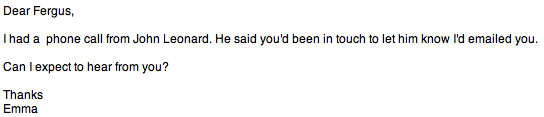
If you double click on that it should become legible. I heard from John Leonard first, who said he'd heard from Dudley that I'd been in touch with him too. So I tried again.


* Read the next post about the BBC folk awards

* If you'd like to receive updates from this blog directly into your Facebook news feed, you could *like* its Facebook page. Or follow me on Twitter @emma1hartley

Emma Hartley blog logo

24hourlondon logo

Did David Hasselhoff End the Cold War?