Me and my blog

Follow me on Twitter @emma1hartley
Showing posts with label All Around My Hat. Show all posts

Tuesday, 10 December 2013

Maddy Prior on Wintersmith, Peter Knight's departure and why being in Steeleye Span is hard

"We haven't learned anything about how to deal with being in a band. 
We've learned nothing. We've never been sensible, that's just never been part of our make-up. A lot of the time there are stresses that are quite unnecessary."

"Terry (Pratchett) has listened to our music from way back," said Maddy Prior. "He was introduced to Boys of Bedlam as a young man and when you read his books you recognise references to our work. He quotes lines from our songs and you sort of recognise them. So he uses 'you love not where you live' which is a song that we do... But he also knows a lot of other material."


I was asking what it was that, in essence, Steeleye Span and Terry Pratchett have in common because after reading Wintersmith - the book on which the band's latest album is based - it struck me that it was more than just an appreciation of each other's work (which has been apparent since Pratchett chose Thomas the Rhymer as his track to keep on Desert Island Discs and Prior says she has read 10-15 of his books). It's as if the sensibility of each is from the same wellspring: something essentially English, historically truthful but also fantastical. They inhabit the same psychic landscape.


Reading Wintersmith, I was particularly moved by Pratchett's witches: complicated, hard-working, under-appreciated women, somewhere between wise and clever (on the whole), with senses of humour but also the knowledge that they might fall off the edge of society at any time. He anatomises the social high wire act of these characters with aching, heartbreaking clarity while also keeping it the right side of sentimental through the usual English device of making a joke out of the whole thing. 

I've also been struck that Pratchett's deep empathy with those characters may go a little further than is entirely usual, in the sense that in public appearances he has often chosen to look as much like one of them as it is reasonable for a man to do.


That's not just me, is it?

Prior began speaking about the history of witchcraft and the patriarchal landscape that real-life so-called "witches" made their way through, recommending a book on the subject that I can see on Amazon is also one of Hilary Mantel's favourites. (Guess what I'm buying myself for Christmas.) "I find it very interesting the way that Terry has presented the witches: they play the game of being scary but... It was a change in social circumstances that led to this myth.

"There had always been wise women and women who knew about herbs and medicine. But suddenly communities were separated form the land and from each other and all the old communal ways of being were ended. One of the ways that remained of surviving was by threatening people if they didn't help you. So it's very interesting to know that during the witch trials you had to prove that you'd done something to a woman to make her put a spell on you: in order to get her convicted you had to explain how you had threatened her. It was a very complicated social manoeuvre and Terry looks at that in a kind of inverted way. 


"The great thing about his books, though, is that there is never total evil, just people getting the wrong end of the stick. He's not so much a feminist as a humanist.

"I'm lucky in that I've never had to deal with really bad situations in life, in which people have no empathy for each other. But I know that it happens and that when it does, it can be... Terry's explanation for all this is that the perpetrators have something missing: it's not deliberate evil in that sense."

Sounds like he's coming at the issue of psychopathy from a very kindly perspective, which is reassuring but not necessarily the response that psychopaths evoke when you meet them. What saves Pratchett's worldview from tweeness is the shadows around the edges, into which people - the witches - will fall when things go wrong. He writes about "cackling" as the gateway to insanity, the thing that witches start to do when they're on their own if things are going badly for them and down which road you find "poisoned spinning wheels and gingerbread cottages". The first time I read that, I shuddered involuntarily, my childhood dread of becoming lost in the Great North Woods or somesuch, plunging to the surface.

So why is Peter Knight leaving the band at the end of the Wintersmith tour?

"I'm not quite sure," said Prior. "Maybe it's time to have a break and do other things. Gigspanner is his baby and that's what he wants to do. It's a bit late on for returns but I would never say it's out of the question."

There was a slight pause. 

"Actually, though, we've only just found out and it's been a very stressful tour as a result. When someone is leaving it changes the dynamics of the band. What we'll do next I'm not sure. He's left before though."


Really?

"Yes. In the 70s. Peter and Bob left and Martin (Carthy) and John (Kirkpatrick) joined. Then a year or so slid by and we reformed with Pete and Bob again. You get something in each musical situation that you're in that you don't get anywhere else and sometimes you miss that. Pete will never get what he gets from Steeleye anywhere else - it's a different dynamic. 

"There has always been a drive in Steeleye that has made it a very powerful band. There is a huge amount of energy, a huge sound that is extremely distinctive that comes from those of us who have been in the band the longest. But it's always been a difficult band to be in."

How do you mean?

"There is a lot of tension: strong personalities and huge dynamics. Never a day goes by that we don't have a row. You would think that after all this time we would get on. But no. Pete is just finding it too much at the moment. 

"But that's actually what makes it a very interesting band. We haven't learned anything about how to deal with being in a band. We've learned nothing. We've never been sensible, that's just never been part of our make-up. A lot of the time there are stresses that are quite unnecessary.

"I look at all these young people navigating their way between bands on the scene these days and think how good they are at that and wonder how they do it?

"But the other side of our equation is that we laugh a lot. Our energy comes out in different directons: very positive and very, very negative. But it's springing out in all directions at the moment. It's amazing that we've lasted this long really.

"I really have no idea what we will do with Peter gone. He's very distinctive: it would be like trying to replace me. It's a voice that nobody else has, a voice in which he has spent 45 years learning how to speak. If somebody else were coming in, it would be difficult."

Still, at the Barbican gig on Monday, Spiers & Boden joined Steeleye on stage for a stunning evening that was notable partly for the look of unadulterated pleasure on the duo's faces and the way they were hanging around at the side of the stage, clearly hoping to be invited to join in All Around My Hat. Well you would, wouldn't you?

As they left the stage again the question: "You wouldn't like to join the band, would you?" floated after them. But I guess that since Spiers & Boden are packing in their double act apparently to devote more energy to Bellowhead, it's hard to see how they'd make time for another folk behemoth...

So what advice would she give her younger self? When I spoke to Peter Knight a few months ago - he broke the news about the Wintersmith project - he spoke with some regret about the lack of business acumen they'd had in the 70s...

"We were never shrewd people and that's the nature of the business. We had fantastic times touring the US, they were great days. We fought and raged and laughed our way around and I wouldn't have missed it. And this is what our lives have been. Why would I change it? The easiest place in the world is the grave and yet we spend our lives trying to make things easy.

"Sometimes this is lovely work. But my experience has been that as soon as you put a lot of energy in, it stops being easy. The more you invest in something the harder it gets and by the end nothing in my life will have been invested in to the same extent as Steeleye, simply in time alone."

A couple of people sent questions about spin-off projects. The first was whether there will be a follow-up to Three for Joy and then there was another, from someone on Twitter calling themselves Fractal Geek, asking how you got into "obscure but fab, odd-tempo east European stuff"? 

"Well, Hannah, Giles and I will be touring with Three for Joy next year, starting in April, and we'll probably record something as well. Hannah is such a little treasure and she and Giles are such a delight to work with. This is what I mean about not getting the same energy with any band..."


"We are looking at yodelling at the moment: I'm trying to get some skills: I've never had any skills particularly."

This seems like an odd thing to say for someone who's in a band that was partly responsible for producing an entire generation of musicians, although given the number of young multi-instrumentalists playing folk these days, I can see where she's coming from.

"Hannah and Giles are both very skilled in lots of different areas. It's difficult to yodel well: to actually control it is quite difficult. But Hannah learned it on an exchange in Finland at Sibelius academy. She's a sponge for learning things and I'm picking up stuff that drops off as she rides by."

And the east European stuff?

"June Tabor and I sang Bulgarian material. It was the first thing we learned together, I think because an album came out on Topic in the 60s and it kind of became a part of our canon. But again, I think it's Hannah who's really nailed this stuff. She goes to ethno-music camps that are often in Slovenia and teaches them English music and in return she learns yodelling and overtone singing."

You're obviously impressed by and fond of Hannah and Giles. What do you think the outlook is for youngsters on the folk scene?

"Traditional music is massive these days, isn't it? All these players: there are so many of them. It's just like it was in the 60s but there are so many of them and they are so much more skilful and they all grew up on it. Hannah's parents went to festivals and took her with them and her mum was in a dance team, which is how she became aware of clogging. I didn't come to all this until I was 17 and there was nobody else doing it. We had to find it ourselves.

"What the youngsters need is a massive audience, whereas what they've got is the same audience we had and quite often exactly the same people. When I was young, people used to say to us 'Why don't you get a proper job?' Whereas these days it seems to have somehow become the proper job, the one where if you play your cards right you can make good money.

"The audience in the US is massive, just colossal. Almost every state is the same size on its own that the UK is." The trouble is finding a way of reaching it, though.

I talked a bit about how the UK's highest profile marketing platform - the BBC folk awards - somehow doesn't seem to see itself as a marketing platform and is, in my opinion, letting the youngsters in the industry down quite badly. The secrecy surrounding the judging process is only the start of it, as I suspect knowing the average age of the judges would reveal the nature of the problem, allowing it to be fixed. (Expect more on this soon, since Fergus Dudley turned out to be saying the things he said last year simply to get me off his back. Nothing has changed.)

"I know what you're saying. I'm not denying that the folk mafia has become a bit... What you need is young producers. There are some in their 30s and 40s. I'm thinking of Bellowhead. But they're really playing to the same crowd that we've always played to. It's the middle men they need, to find a new market for them. It is a problem.

"It's the same in Scotland. They have a massive number of players. But it's almost that nobody English is going up there any more and nobody Scottish is coming down here. That border has become very strong. I live nine miles from the border and I think it's an independence thing. I don't quite know what has happened: perhaps that country's resentment has just come to fruition?"

It's been a pleasure, Maddy.

* You can buy the beautiful Wintersmith album, here. And Terry Pratchett's quietly brilliant book here, where there is also a Terry Pratchett blog.

* If you'd like to receive posts from this blog directly into your Facebook newsfeed, you could *like* its Facebook page and then use the drop-down menu to indicate that it's one of your "interests". This will enhance the possibility that you'll get them. You could also follow me on Twitter @emma1hartley

Thursday, 11 July 2013

Ade Edmondson on being a bad shepherd

He talks really fast.

Ordinarily this wouldn't matter very much but I got the sense that he'd just finished another telephone interview and was therefore thoroughly warmed up, talking-wise, whereas my shorthand takes a while to crank into gear. I mention this because while we were out of sync he was saying some interesting stuff, so it's a shame that you'll be missing some of it...


I saw him and his Bad Shepherds - Troy Donockley and Andy Dinan in the band's present incarnation - at Folk by the Oak in 2011 and had the exact experience that he describes to me during our conversation: despite their performance being freighted with the expectation that it would be funny, I was pleasantly surprised by the quality of the musicianship and impressed at how hard they were working to subvert my expectations. It was a beautiful afternoon and they played versions of punk-era songs on traditional instruments, including Uilleann pipes, with Edmondson on mandolin. Then they made me laugh harder than I've laughed at a folk festival before or since by doing a punk version of All Around My Hat with a lyric that ran like this...


"We used to do that version of All Around My Hat because I was embarrassed that people would want comedy," he explained. "But the more we took the funny stuff out, the better the gig became because the more people actually listened to what we were playing.

"What we're aiming for is joy rather than humour. People hear things at our gigs that they are vaguely familiar with" - they usually start with Anarchy in the UK - "and then there's a difference between what they are used to and what they remember - and it amounts to something different again. There's this great thing that happens at festivals: people come to us with an expectation that it's going to be shit and then we win them over. It's like fly fishing."

Edmondson as Vyvyan in The Young Ones is an edgy childhood memory for me that eventually shaded into warmth, though I never came round to Bottom, in which he worked again with his university friend Rik Mayall. "A lot of women say that," apparently.

There was, however, a level of hysteria to his television characters that bumps awkwardly against his present, fly-fishing orientated, media incarnation, in which he presents a TV show called Ade in Britain (see what they did there?) that follows him as he goes around the country being nice to people, and plays in a folk band. I put it to him that he may have turned into a codger.

"Have I got a codger in me?" he deliberated. "I think of a codger as someone who is full of their own self-importance."

Ah well then, we should define our terms. I think of a codger as a man of certain age who wears a hat.


"Well, I do wear a hat, I think the world was a better place when we all wore hats. I like looking at pictures of men walking to Wembley stadium in the 1930s, all of them wearing hats, and wondering why on earth we stopped wearing them?"

Did umbrellas become the cheaper option? Hats seem quite pricey these days...

"I like them because they frame your face, especially if you've got a head like mine that looks like an onion. I started wearing them to keep my head warm because I don't have much hair, but think that they frame my face and make my features look better."

And is tweed your jam? (I may have been encouraging the hat-talk.)

"I have a couple of tweedy flat caps and then a black one because I like to change my mood now and then. Also, you should wear a hat in this weather," he said as the temperature outdoors crept into the low 80s "to prevent your head splitting open like a tomato."

I've noticed that ordinarily when interviewers ask how you ended up being in a folk band, you tell them that it was an accident.

"And you don't believe that?"

It seems a bit unlikely. Here's a video they made in 2008 about how the band started.

"It is slightly disingenuous to say that it was an accident. I have a history of enjoying folk. I'm in my late 50s and the pop charts of my youth were full of folk instruments. Rod Stewart... there was mandolin all over everything. And then the drama department at Manchester University had this pub we all went to that was an Irish session pub. So we'd go from watching a session there to the squat, where we'd watch punk bands wearing bin liners. And these kinds of music seemed very similar to me, equally thrilling."

Do you still find it thrilling?

"I love watching The Unthanks."

Well, yes. But I read that you don't relate to the bucolic side of folk?

"I don't quite understand the reason for singing songs about blacksmiths and jolly milk maids. It seems a bit anachronistic - unless it's a timeless metaphor that actually means something else." I've had similar thoughts myself, which set me off.

I waffled on for a while about how the act of recording music has changed its nature and how these days, because of digitisation, bands are competing against every other band that has ever existed rather than just the ones that are fighting to get into the chart that week. I mentioned the Rolling Stones at Glastonbury and how all the teenagers knew the words to their music. I may also have mentioned the coconut tree.

"I heard another brilliant story about Keith Richards falling off a ladder in his library," Edmondson giggled. "It was good not just for the idea that Keith Richards has a library... but that it is so vast that he needs a ladder for it.

"It would be interesting, though, wouldn't it, to find out what songs we'd all know if recording studios had never been invented? We wouldn't be able to listen to Jacques Brel, we'd be relying on whoever was keeping the songs alive by performing them.

"I don't know really what it means to be a young musician these days. Everyone is recording themselves all the time."

I ventured that all this recording may have elevated the role of the promoters and middle men. I mean, when everyone can record because the technology is no barrier to entry, the scramble becomes for other people's attention and it becomes much more important to understand the buttons and levers of the industry. Hence, perhaps, the number of musicians who are also graphic designers who have cropped up on this blog recently. Their trade - graphic design - is all about commodification and promotion.

However, being famous for something else is another way of getting a band off the ground, I suppose?

"I wouldn't recommend it as a way to become a musician: pretending to be a comedian for 30 years. Although the notoriety is kind of a plus, trying to persuade people that you mean what you're doing is difficult. Getting them to listen is quite hard: you wouldn't believe the number of interviews I do with people who haven't listened to us and never will."

How ambitious are you for The Bad Shepherds? Is there anyone in particular you'd like to play with?

"I'd like to get Andy Cutting into the band, though he doesn't know that yet."

Glad to be of service. I detected from reading your blog that you're not a massive fan of camping? For instance, you said that the Glastonbury festival smells like human excrement...

"Ah. That must have been from a few years ago. We didn't go this year, I just haven't got around to updating the blog much."

Good to see that you're really getting the hang of being a folk musician then...

"I don't camp unless I can help it because it hurts your bones. I'd go as far as to say it's bad for your bones. I wouldn't mind being in a big camper van but I really can't camp because it's so hard on the hips. People roll out those thin little mattresses... Ouch. When the kids were small" - he has three daughters with his wife Jennifer Saunders - "we had to pretend to enjoy camping. But I like hotels.

"What I do enjoy, though, at festivals is teasing people from the stage about the fact that they're camping.  'It was raining last night, wasn't it? It was really banging on my hotel window', that kind of thing. We've done a lot of festivals, this band, and we like to arrive a day early and then stay a day later, wobble around and get drunk. But we stay in a hotel nearby in order to do it.


"Glastonbury was like some kind of hippy refugee camp. You know, we used to get paid in cash when we started out and once, at Glastonbury, Troy left the van open and there was a bag in the back of it with about fifteen grand in it in cash and no one nicked it. How we laughed about that - before we punched Troy in the face. That was back in the days when we didn't trust promoters but we've got ourselves a better agent now."

Oh right. Who's that then?

"Matt Bartlett. He was a promoter and we were so pleased with him that we turned him into a manager. There's so much work connected with gigging that isn't actually gigging... Getting contracts out and that kind of thing."

Ah yes. The whole trying to get paid shenanigans.

"We've been to court from time to time to try and get a contract enforced but the trouble with that is that even if you win you still end up with nothing because of all the fees you have to pay. We've tried chasing them but these days we just deliver a lot of paper."

I also read in that rather-out-of-date blog that you once managed to lock yourself out of a hotel room when you were completely naked?

"That was at the Ibis in Liverpool. There had been a lot of drinking, as you would probably expect, and the toilet door was on a curved wall. I was trying to feel my way to it in the dark and went through the wrong door. If it wasn't for the fact that the staff there were all foreign" and presumably therefore didn't know who Edmondson was "I'm sure that video would have ended up on YouTube. It was all caught on CCTV. I walked boldly into the foyer covering myself with my hands."

You didn't try sticking your head around the corner first? I think I probably would have tried that...

"No. There was only one way to do that particular thing unfortunately."

I mentioned to a couple of people that I was going to be interviewing you and they both said the same thing, which was: "He's married to Jennifer Saunders, you know." I understand she's been unwell: is she OK these days?

"Yes. She's been very well for a couple of years now, though I don't think you ever get the all-clear from breast cancer. They just keep doing tests every once in a while."

And all this stuff about John Inverdale over the weekend: the casual sexism of the BBC's Wimbledon coverage. As the father of three daughters was there ever anything you said to them that was an attempt to prepare them for that kind of thing?

"I don't tell them anything about men. They are all grown up and have left home now: one is married and the other two have permanent boyfriends and I think they've all chosen extremely well. They're lovely blokes. In fact I think for the lot of them there were only two bad boyfriends in 30 years and that's not bad going, is it?

"I think you live by example, don't you? I sometimes wonder whether we've been strict or liberal parents but I actually feel that my daughters are such perfect people that we must have done all right. I really don't understand these men who say 'Three daughters? You must have been at the door with a shotgun!' I mean, why would you not want your daughters, who are in their twenties, to have fulfilling sexual relationships? That's what life is all about, isn't it?"

And what about Mumford & Sons? Any strong feelings one way or the other?

"We saw them at Cambridge a couple of years ago. They were first on the bill and we were headlining that time. Ha! We were supported by Mumford & Sons... I watched them from the side of the stage and thought they were fucking brilliant. I downloaded their stuff from the web and listen to the original - it was from before they rerecorded the first album - and love it. I know people who hate them but they've got a great vocalist. I love his singing."

Ade in Britain: what came first, the idea for the series or the title?

"I came up with the series idea and they came up with the title. I'd had an awful name for it originally though I can't remember what it was. I'd done the Dales and they asked whether there was anything else I'd like to do, so I came up with something based on this book called England in Particular by Sue Clifford and Angela King. Quite often the programmes include folk bands and I must be the main conduit for morris dancing on national TV. In 50 episodes I think we've had seven or eight morris sides."

So what's next on the telly?

"There's a short series on beer in development. I'm trying to convince BBC2 to take it."

Can I recommend a blog by a friend of mine that's about that exact thing?

"Is it the one with the funny name?"

Yes! Zythophile by Martyn Cornell. I used to work with him.

"I've read it. It's a bit historical in places but it was one of the first things I looked at when I started doing some research. It's fascinating to think beer was invented in Iran..."

* Ade Edmondson and the Bad Shepherds have a new album out on August the 19th called Mud, Blood and Beer and will be touring to promote it in November and December.

* If you enjoyed this post, you may also like this, which is an interview with actor and folky Stephen Mangan. Or this, which is a Desert Island (folk) Discs with David Oakes, star of The Borgias and The White Queen.

* If you'd like to receive posts from this blog directly into your Facebook newsfeed, you could *like* its Facebook page and then use the drop-down menu to indicate that it's one of your "interests". This will enhance the possibility that you'll get them. You could also follow me on Twitter @emma1hartley

Emma Hartley blog logo

24hourlondon logo

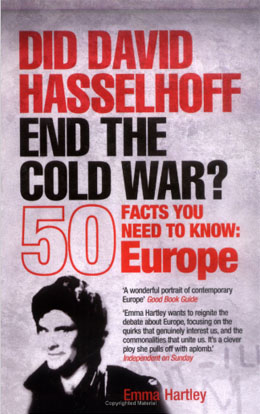
Did David Hasselhoff End the Cold War?