Me and my blog

Follow me on Twitter @emma1hartley

Saturday, 25 January 2014

Is Llewyn Davis a loser?

* Contains spoilers. Sorry.

The Coen brothers' latest film, Inside Llewyn Davis, is about a lush-bearded folk singer, played by Oscar Isaac - who looks a lot like British actor and folky Stephen Mangan - in Greenwich Village, New York, in the early 60s. The tale is reputedly based on the life of Dave Van Ronk, who released a similarly named album, Inside Dave Van Ronk, at around this time. And the movie is a beautiful thing: majestically shot, well told and provoking. In particular it invites the question of whether Davis is a loser, and thus also, slightly uncomfortably, whether we are ourselves losers?


I read this review, which takes a very clear line on the question, before seeing the movie at the Genesis in Mile End and thought about it again as I left the cinema because it wasn't as clear cut as the Indy had led me to expect. In the Guardian Peter Bradshaw took a slightly more forgiving approach and while picking up on telling details - the different meanings that a box of unsold records (or books) have to their originator and everyone else - Bradshaw's take on the central question seems to me to be the wrong one. Bradshaw thinks the central question is "Is Davis any good?" when we all know that completely depends on your musical taste.

So, while encouraging you to go and see the film, because it's terrific and has been overlooked by the Oscars and its attending publicity (probably because it's unusually downbeat), I'm going to do a list of pros and cons. Sometimes a list helps.

If the answer to the question "Is Llewyn Davis a loser" is yes, then it would be because

* He, self-defeatingly, turns down a clear opportunity to try out for a new band when a Chicago agent, played by F Murray Abraham - whom he has gone on a desperate road trip to meet in exactly the hope that an opportunity would present itself - offers it to him.
* He plays an underwhelming, rather twee song to the aforementioned agent, when the final couple of scenes demonstrate that he's capable of better.
* He has a sourness about him that is unattractive unless you respond to the urge to fix people.
* He clearly - judging by his ongoing relationship with an abortionist - struggles with using a condom.
* He signs away his royalty rights to an upbeat song that turns out to be a hit.
* He is rude about an elderly female folk singer, which leads her husband to beat him up in the opening and closing scenes of the film.


However, the great thing about this film - one of them, anyway - is that all of the above happen for perfectly understandable reasons that force you to ask: would I have behaved any differently? So

* He turns down the audition because he's had a musical partner already, a friend who committed suicide, and this leads him to want to avoid partnering up again.
* The best music in the film comes from the period of Davis's life when he was with his dead friend, so he plays newer, more downbeat material at the audition instead.
* His "sourness" is completely understandable in the context of this bereavement. He is depressed. That's all: a small thing and a big one.
* It materialises that of the two girlfriends who have required the attention of an abortionist, one of them kept his child after all, while the most recent - Jean, played by Carey Mulligan, the real-life wife of Marcus Mumford - turns out to have slept with at least one other man behind the back of her boyfriend Jim - played by Justin Timberlake. While this does not nullify Davis's responsibility in the matter - it could still be his baby - it does undermine her stated reason for hating him (which helps us form a view of him early on), which is that if he hadn't been a loser who slept with other people's girlfriends, her baby would definitely have been Timberlake's. Hmm.
* He signs away the royalty rights because he needs cash in hand to pay for the abortion.
* And finally, while being rude to another, less successful musician is reprehensible, the context is that he has just discovered that the guy who runs the folk club has slept with Jean. His outburst is a direct result of this and begins with a pointed heckle, asking how the elderly lady got the gig (since the folk club guy has just said if people want to play at his club this is what it takes).

Other things that mitigate Davis's loser status include

* This is about one week in his life and we've all had bad weeks
* We can't all be Bob Dylan, whose character appears in the background to one of the final scenes. In fact, to set the bar that high denotes a childish, black-and-white view of the world: Dylan is possibly the most successful musician who has ever lived.
* People clearly like Davis. Women sleep with him and he has friends, enough to support his couch-surfing lifestyle.
* When we see Davis working in a studio he cooperates beautifully, does exactly what he's asked and is involved in producing a successful record.
* He takes his responsibilities - to his girlfriends, his friends and their cats (I'm not going to explain that, you have to go see it) - seriously.


But most of all, the reason why Llewyn Davis is a hero of sorts is because he is giving it a go. A lot of people would have allowed themselves to be dragged under by the suicide of their musical partner. Yet Davis, despite being seriously depressed, has got back in the saddle and perseveres: even when it looks as if he may have to leave the music industry he immediately sets about finding another job.

Defining someone as a loser when most of the bad stuff that happens to them is not of their own making is to ignore that success is mostly about turning up.

The losers are those who never try. Llewyn Davis is a survivor - which, in the grand scheme of things, is right at the top of the tree.

* If you'd like to receive posts from this blog directly into your Facebook newsfeed, you could *like* its Facebook page and then use the drop-down menu to indicate that it's one of your "interests". This will enhance the possibility that you'll get them. You could also follow me on Twitter at @emma1hartley

Saturday, 11 January 2014

Daylight Music and Ben Eshmade, podcaster

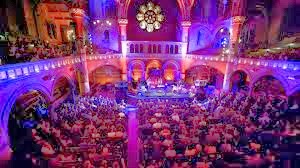
Going to Daylight Music at Union Chapel in Islington for the first time was a where have you been all my life? experience for me. It's a free Saturday lunchtime concert, midday to 2pm, of three mainly contemporary, often folky music acts, where you can get a bacon butty and a cup of tea... allowing your Saturday to fade in gently, in exquisite surroundings. It's a perfect start to the weekend, the best imaginable reason to get out of bed on a Saturday morning and handy for anyone planning a weekend in London as it's right next to Highbury & Islington tube.


For five years this April Daylight Music has been run by Ben Eshmade, 37, (below, right) who it seems to me is remarkable for this reason alone. But also because he might be the only person in the UK who makes a whole living as a music podcaster. The awkward term "content provider"could have been invented for him and Daylight Music is, wonderfully for the rest of us, what he does for fun.

He started out traditionally enough. "I did English and music at the University of Essex and then took a temping job at Thames Water in Colchester," he explained on a leather sofa at the cafe in at Kings Place, one of the music venues where he now works.


"I spent a lot of time getting the Guardian every Monday, applying for every media job I could see and not getting replies. Then I sent off a demo tape to five or six radio stations and got a reply from Essex FM, which I'd only added to the list at the last minute, as an emergency thing. I went back to living with my mum and dad while I did one day a week's work experience there.

"I eventually landed a job in the 'traffic department', which schedules adverts, and ended up doing that for about nine radio stations in the group. It was a very stressful job. But the thing was that when I joined I realised that the email system linked me up with everyone who worked for the same company, which was quite a lot of different stations, including Classic FM.

"I had a bit of luck when someone I know who plays the trombone - I'm a French horn player - went to work at Classic FM and I got a late Friday shift, which involved keeping things ticking over at a time when there was hardly anyone around. There were quite a few months of rushing backwards and forwards between Southend and Colchester in the middle of the night but I ended up getting a full-time job there."

He worked on a late-night show on Classic FM called The Chiller Cabinet, which sounds like a kind of post-club come-down, featuring Balearic beats and involving no talking on his part whatsoever. But it was also a first shot at curating a music show.

"When the Chiller Cabinet ended on Classic FM I was desperate for it to continue," he explained. "So I set up Arctic Circle, with the name referencing the same idea, and started putting on some shows around London. The first one I did was at the Hayward Gallery on the Southbank. There was also one at the Tate called The Lovers, The Dreamers and Me featuring Emily Barker that didn't sell out exactly because there weren't any tickets. But I couldn't get into the room where it was going on."

These days he works for Kings Place and the Barbican as a podcaster, recording interviews with the acts that are scheduled to appear, which are made available through iTunes and Soundcloud, and then using the resulting material for guide articles and programme notes.

"No, I don't know anyone else who does this," he admitted, responding to a question about what he would do when the technology moves on, as it's bound to eventually. "But it's really just audio in a particular format: there'll always be another format. What a podcast is now, among other things, is a way of instantaneously selling a live performance to someone by telling them about it.

'The thing is that I left radio as it was shrinking and shrinking. It seemed as if creativity was frowned upon because it was regarded as expensive. But the beauty of Mixcloud and Soundcloud is that you don't have to tune in at a certain time to hear what you're searching for. You can listen whenever you want."

These days Ben's output includes the spoken word and he admits that he'd love a traditional job as a radio DJ. But what kind of music would he play? When I asked him this question he began to talk about The Sherman Brothers, who wrote much of Disney's early musical material, and Saving Mr Banks, the recent film starring Emma Thompson about the making of Mary Poppins, in which their characters appear.


In fact, although his musical predilections appear strongly to feature things associated with childhood - he also loves Totoro, the fantastical Japanese Ghibli character (above) - I think the variety in his work is as much about necessity and circumstance as anything else: when you're freelance you have to be flexible.

This much is true though. First, he recently produced a charming CD called The Age of Not Believing, whose title references Bedknobs and Broomsticks. "It includes some of everything that's happened in my life up until now," he says, and Emily Barker is on it, singing Hushabye Mountain.

And second, he chooses three bands every week for Daylight Music. So what do they have in common? "There are submissions and recommendations. Occasionally I'll hear about a band and contact them myself but these days a lot of bands contact me online via the Daylight Music site. What I look for when I'm putting together a show is diversity. Oh god. That makes me sound like a bad politician, doesn't it?


"What I mean is that I like choirs and tuba quintets, and once there was a band called Transept who hooked a tree up to a microphone and found a way of playing it. The Transiberian Marching Band and the London Bulgarian Choir both went down a storm, as did those female morris dancers The Belles of London City. Singer songwriters with guitars, on the other hand, find it quite hard to make an impact in Union Chapel, as do guys with laptops, sitting at their laptops. And I tend to avoid acts with agents and managers, though a lot of people who've played at Daylight Music have gone on to do very well. The Leisure Society, for instance. And then there's Nils Frahm, who's playing at the Barbican this year, and Francois and the Atlas Mountains."

Singer songwriters need not despair, though: I've seen some at Daylight and I think what Ben means is that they just have to be extremely good. He also says that he often invites musicians who are subdivisions of other acts he's put on.

"I'm particularly fascinated by the emails that bands send along and how they present themselves. I don't know what anyone else likes, but personally if I'm getting an unsolicited email from a band that wants to play, I'm looking for a short, polite note and a direct link to their music. You wouldn't believe how many people will send a link to their website that has no actual music on it as far as one can see. I particularly like a link to a live performance on YouTube as it's impossible to fake a good live performance. I'm not interested in long rambling histories and mentions of famous people who've said something nice about them. The music is all that matters."

So what's in it for the bands? Do they get paid? "Hmm. I'd be grateful if you could play that down in the article as the emphasis is really on the day as a special event. But we try and make sure that expenses, at least, are covered from the voluntary take on the door." (There is a recommended donation of £3.50 per person and Daylight has been known to pack in as many as 600.) "But over the years what we have been able to offer has evolved into a kind of Daylight Music care package. I try and make sure everyone gets a cup of tea on the way in, we have a team of ten now, including photographers, and we do everything extremely quickly and efficiently.


"There is a professional sound engineer who has two assistants, so what we offer is the opportunity to play what Time Out has described as 'the best venue in London' where we will make you sound as good as you've ever sounded. We have volunteers who will sell your CDs and merchandise for you at the back of the venue and if your performance captures people and you have a reasonably priced CD, you may sell up to 20."

I suppose one of the things about it being in Islington is that you never really know who's going to be in the audience? "Yes. I should say, though, that we've recently had to add a kind of buggy park area because so many people with young families have taken to coming along. And what that means is that we are the first gig that a lot of children ever come to - which is kind of amazing really. But it can also mean that especially quiet, soulful performances can sometimes get a little bit disrupted."

The thing I needed most urgently to ask, though, is why it is so often impossible to get a bacon butty if you arrive after 1pm? The food tables at the back are run by the Margins cafe project, which does a lot of work with the homeless at Union Chapel, including feeding around 200 every Sunday. Some of them return and volunteer, so it's obviously good for getting structure back into people's lives. But, if I get there after all the bacon has run out - which seems to happen quite often - it feels like a barometer of how the rest of my weekend is going to turn out.

Ben laughed, not unkindly.

"Yes. I have on occasion got one of our volunteers to go to the supermarket over the road and buy stuff for Margins. They're characters and they run it in their own unique way: with a lot of enthusiasm but not always getting the quantities right."

There's nothing like bacon as an incentive for getting out of bed earlier.

* If you enjoyed this post and thought it may be useful professionally to you or someone you know, you may also like this, about how Seth Lakeman's music ended up being played on Coast. 

* If you'd like to receive posts from this blog directly into your Facebook newsfeed, you could *like* its Facebook page and then use the drop-down menu to indicate that it's one of your "interests". This will enhance the possibility that you'll get them. You could also follow me on Twitter at @emma1hartley

Wednesday, 11 December 2013

Letter to John Whittingdale MP, chairman of the culture, media & sport select committee, about the BBC Radio 2 folk awards and its anonymous judges

Dear Mr Whittingdale, 

Lovely to meet you last night: I'm so sorry I couldn't stay for dinner. 


As I said, I'm a professional journalist - presently at the Guardian as a sub-editor, formerly at the Telegraph as an associate editor - who writes a music blog.

http://theglamourcave.blogspot.co.uk/

Two years ago I met someone who was a judge for the BBC folk awards and, thinking this might be interesting as there is usually a chorus of moaning about the nominees (the same names seem to come up every year, is the gist of it), did an off-the-record interview with them about it. The reason the interview was off the record was that the judge I met was under the impression that the names of the awards' judges were supposed to be a secret. There was some confusion around this. Mike Harding, who presented the BBC Radio 2 folk show at the time, said the names weren't a secret. 

http://theglamourcave.blogspot.com/2011/11/bbc-folk-awards-raising-blood-pressure.html

But then John Leonard, who runs Smooth Operations, the production company that produces the folk show and the folk awards for the BBC, waded in and not only said that, yes, they were a secret, but also came up with an elaborate justification for this.

http://theglamourcave.blogspot.co.uk/2011/11/smooth-operations-and-bbc-compliance-on.html

It turned out that the BBC has guidelines for running awards that specify transparency as one of the criteria

http://www.bbc.co.uk/editorialguidelines/page/guidance-interactivity-awards

so I submitted a freedom of information request to the relevant department at the BBC 

http://theglamourcave.blogspot.co.uk/2011/12/freedom-of-information-request-for.html

only to be told that the request for the names of the judges had been denied because the BBC folk awards are "journalism" and therefore excluded from submitting to FoI rules. Since I'm the journalist in this scenario, that was ridiculous. It made me wonder why go to all this trouble instead of simply supplying the names? By this stage there was so much interest that one would assume it would simply have been easier to supply the names.

Roy Greenslade at the Guardian had picked up the story

http://www.theguardian.com/media/greenslade/2011/dec/13/radio-2-awards-and-prizes

as did The Independent

http://www.independent.co.uk/arts-entertainment/tv/news/could-it-all-be-a-fiddle-folk-stars-tell-the-bbc-to-reveal-who-judges-awards-6358939.html

But nothing occurred until the next year, when a month or so before the nominations were announced I received a phone call from Fergus Dudley, head of compliance at Radio 2, saying that there were going to be some changes to the folk awards to make them more transparent

http://theglamourcave.blogspot.co.uk/2012/10/change-at-bbc-radio-two-folk-awards.html

I was invited by Fraser Nelson at the Spectator to write a piece at this stage about why it was important

http://blogs.spectator.co.uk/coffeehouse/2013/01/bbc-radio-2-folk-awards-bottom-of-the-class/

And that was basically where it lay until this year, when the awards nominations were announced in November and it became clear that Dudley's hints and suggestions about naming the judges this year were only that, and had apparently been designed to get me off his back. In response to my inquiries directly to Fergus Dudley and John Leonard I got an email from a junior press officer who was unaware of the history of the request.

This all sounds a bit specific and of interest only to folkies. But the BBC Radio 2 folk awards is the best marketing platform the UK acoustic and roots music industry has, although it does not appear to see itself in this way. There are, I understand, over 180 anonymous judges for these awards, all of whom by Smooth Operations' own admission, have a financial stake in the industry. This is the qualification for the job and many of them know each other. In fact they are laughingly referred to as the "folk mafia" (see my latest post, an interview with Maddy Prior of Steeleye Span, for an example of this). When I started writing about the awards the first thing John Leonard did was try to co-opt me by inviting me to become a judge. 

Mumford & Sons are the biggest band in the world right now and to the rest of the world they are an English folk band. But no other English folk bands have benefited from this surge in international interest, despite there being a folk scene in the UK that is full to overflowing with young talent struggling to get by, because the industry's biggest marketing platform - the BBC Radio 2 folk awards - has never invited Mumford & Sons to take part, nor have they ever nominated them for an award for reasons explored in the Spectator piece. Instead, and despite a constant throughput of new young bands that need a boost in a difficult environment, the same bands run by the same handful of middle men and women get nominated every year, as if folk were a niche thing. Indeed, John Leonard argues that it is, which in his case is self-fulfilling. For instance, Laura Marling has had three unsuccessful Mercury nominations now, as if she were the only young British folk musician the industry-wide Mercury judges have heard of.

Here is a link to a recent More 4 documentary about the groundswell going on in the British folk industry saying many of the same things I'm saying here: I had nothing to do with its production. It is also worth noting that the documentary is one of the few pieces of TV folk output in this country that has had nothing to do with Smooth Operations, which also does much of the folk festival coverage for Sky. 


This is a British industry crying out for the kind of help that the BBC is ideally suited to provide, indeed is supposed to be providing. But instead the BBC runs the awards as if they were a club for John Leonard's mates from the folk clubs of the 60s and 70s adding ever more "lifetime achievement awards" each year. These clubs are no longer relevant to a young generation of musicians financially crippled by college debt who can't afford to go touring up and down the country's folk clubs, which are - it often seems - entirely populated by people who are themselves in their 60s and 70s: this is not ageism, they are simply a very small section of the music-buying, gig-going public. John Leonard, it seems to me, is confused about folk clubs' relevance these days. Young musicians rely on the web for marketing when they are starting out, as every other industry does, but there's no indication from the awards nominations that the judges are even aware of the web, focusing on bands that have been around for four years or longer. There is a separate section for "young" musicians, which does little justice to the breadth and scope of what's out there.

Britain's creative industries are one of its great exports, I believe that the UK market is simply too small to support the amount of folk, roots and acoustic talent we have on these shores and that the BBC institutionally is not pulling its weight in this regard. I also think that if they named the judges of the folk awards, as Fergus Dudley (head of radio 2 compliance) suggested they would before doing a U-turn, we would see why the awards nominees are pulled from such a shallow pool of talent. (I have been told that there are judges on the list who haven't left their own homes for months, relying entirely on the Mark Radcliffe Radio 2 show for their information about what's new.) The fact that this has not been done, moreover, suggests that the BBC knows it has something to hide.

My campaigning on this issue has received an enormous amount of support from folk music fans and musicians, which is evident from the comments on the blogs, as well as emails and personal messages of support when I'm out and about. In particular Phil Widdows at Folk Cast has also campaigned on this.

I would be enormously grateful if you were able to pass this to the people at the committee who regularly deal with the BBC, to see if anything can be done: if any questions could be asked of Fergus Dudley about his intransigence on a matter that seems so cut and dried even by the standards of the BBC's own guidelines? I believe naming the folk awards judges would eventually have a knock-on effect for the music industry in this country that would be wildly disproportionate to the effort involved.

I also believe that the BBC's FoI office is "broken" and would be grateful if you could add my evidence to anything similar you have on the same subject.

All best wishes
Emma Hartley

* If anyone else would like to email John Whittingdale, to add support to my email, you can reach him at john.whittingdale.mp@parliament.uk This is a constituency office email address, but if you label the email "BBC folk awards, anonymous judging" it should reach the staff who deal with his duties as chairman of the culture, media and sport select committee.

* If you'd like to receive posts from this blog directly into your Facebook newsfeed, you could *like* its Facebook page and then use the drop-down menu to indicate that it's one of your "interests". This will enhance the possibility that you'll get them. You could also follow me on Twitter at @emma1hartley

Tuesday, 10 December 2013

Maddy Prior on Wintersmith, Peter Knight's departure and why being in Steeleye Span is hard

"We haven't learned anything about how to deal with being in a band. 
We've learned nothing. We've never been sensible, that's just never been part of our make-up. A lot of the time there are stresses that are quite unnecessary."

"Terry (Pratchett) has listened to our music from way back," said Maddy Prior. "He was introduced to Boys of Bedlam as a young man and when you read his books you recognise references to our work. He quotes lines from our songs and you sort of recognise them. So he uses 'you love not where you live' which is a song that we do... But he also knows a lot of other material."


I was asking what it was that, in essence, Steeleye Span and Terry Pratchett have in common because after reading Wintersmith - the book on which the band's latest album is based - it struck me that it was more than just an appreciation of each other's work (which has been apparent since Pratchett chose Thomas the Rhymer as his track to keep on Desert Island Discs and Prior says she has read 10-15 of his books). It's as if the sensibility of each is from the same wellspring: something essentially English, historically truthful but also fantastical. They inhabit the same psychic landscape.


Reading Wintersmith, I was particularly moved by Pratchett's witches: complicated, hard-working, under-appreciated women, somewhere between wise and clever (on the whole), with senses of humour but also the knowledge that they might fall off the edge of society at any time. He anatomises the social high wire act of these characters with aching, heartbreaking clarity while also keeping it the right side of sentimental through the usual English device of making a joke out of the whole thing. 

I've also been struck that Pratchett's deep empathy with those characters may go a little further than is entirely usual, in the sense that in public appearances he has often chosen to look as much like one of them as it is reasonable for a man to do.


That's not just me, is it?

Prior began speaking about the history of witchcraft and the patriarchal landscape that real-life so-called "witches" made their way through, recommending a book on the subject that I can see on Amazon is also one of Hilary Mantel's favourites. (Guess what I'm buying myself for Christmas.) "I find it very interesting the way that Terry has presented the witches: they play the game of being scary but... It was a change in social circumstances that led to this myth.

"There had always been wise women and women who knew about herbs and medicine. But suddenly communities were separated form the land and from each other and all the old communal ways of being were ended. One of the ways that remained of surviving was by threatening people if they didn't help you. So it's very interesting to know that during the witch trials you had to prove that you'd done something to a woman to make her put a spell on you: in order to get her convicted you had to explain how you had threatened her. It was a very complicated social manoeuvre and Terry looks at that in a kind of inverted way. 


"The great thing about his books, though, is that there is never total evil, just people getting the wrong end of the stick. He's not so much a feminist as a humanist.

"I'm lucky in that I've never had to deal with really bad situations in life, in which people have no empathy for each other. But I know that it happens and that when it does, it can be... Terry's explanation for all this is that the perpetrators have something missing: it's not deliberate evil in that sense."

Sounds like he's coming at the issue of psychopathy from a very kindly perspective, which is reassuring but not necessarily the response that psychopaths evoke when you meet them. What saves Pratchett's worldview from tweeness is the shadows around the edges, into which people - the witches - will fall when things go wrong. He writes about "cackling" as the gateway to insanity, the thing that witches start to do when they're on their own if things are going badly for them and down which road you find "poisoned spinning wheels and gingerbread cottages". The first time I read that, I shuddered involuntarily, my childhood dread of becoming lost in the Great North Woods or somesuch, plunging to the surface.

So why is Peter Knight leaving the band at the end of the Wintersmith tour?

"I'm not quite sure," said Prior. "Maybe it's time to have a break and do other things. Gigspanner is his baby and that's what he wants to do. It's a bit late on for returns but I would never say it's out of the question."

There was a slight pause. 

"Actually, though, we've only just found out and it's been a very stressful tour as a result. When someone is leaving it changes the dynamics of the band. What we'll do next I'm not sure. He's left before though."


Really?

"Yes. In the 70s. Peter and Bob left and Martin (Carthy) and John (Kirkpatrick) joined. Then a year or so slid by and we reformed with Pete and Bob again. You get something in each musical situation that you're in that you don't get anywhere else and sometimes you miss that. Pete will never get what he gets from Steeleye anywhere else - it's a different dynamic. 

"There has always been a drive in Steeleye that has made it a very powerful band. There is a huge amount of energy, a huge sound that is extremely distinctive that comes from those of us who have been in the band the longest. But it's always been a difficult band to be in."

How do you mean?

"There is a lot of tension: strong personalities and huge dynamics. Never a day goes by that we don't have a row. You would think that after all this time we would get on. But no. Pete is just finding it too much at the moment. 

"But that's actually what makes it a very interesting band. We haven't learned anything about how to deal with being in a band. We've learned nothing. We've never been sensible, that's just never been part of our make-up. A lot of the time there are stresses that are quite unnecessary.

"I look at all these young people navigating their way between bands on the scene these days and think how good they are at that and wonder how they do it?

"But the other side of our equation is that we laugh a lot. Our energy comes out in different directons: very positive and very, very negative. But it's springing out in all directions at the moment. It's amazing that we've lasted this long really.

"I really have no idea what we will do with Peter gone. He's very distinctive: it would be like trying to replace me. It's a voice that nobody else has, a voice in which he has spent 45 years learning how to speak. If somebody else were coming in, it would be difficult."

Still, at the Barbican gig on Monday, Spiers & Boden joined Steeleye on stage for a stunning evening that was notable partly for the look of unadulterated pleasure on the duo's faces and the way they were hanging around at the side of the stage, clearly hoping to be invited to join in All Around My Hat. Well you would, wouldn't you?

As they left the stage again the question: "You wouldn't like to join the band, would you?" floated after them. But I guess that since Spiers & Boden are packing in their double act apparently to devote more energy to Bellowhead, it's hard to see how they'd make time for another folk behemoth...

So what advice would she give her younger self? When I spoke to Peter Knight a few months ago - he broke the news about the Wintersmith project - he spoke with some regret about the lack of business acumen they'd had in the 70s...

"We were never shrewd people and that's the nature of the business. We had fantastic times touring the US, they were great days. We fought and raged and laughed our way around and I wouldn't have missed it. And this is what our lives have been. Why would I change it? The easiest place in the world is the grave and yet we spend our lives trying to make things easy.

"Sometimes this is lovely work. But my experience has been that as soon as you put a lot of energy in, it stops being easy. The more you invest in something the harder it gets and by the end nothing in my life will have been invested in to the same extent as Steeleye, simply in time alone."

A couple of people sent questions about spin-off projects. The first was whether there will be a follow-up to Three for Joy and then there was another, from someone on Twitter calling themselves Fractal Geek, asking how you got into "obscure but fab, odd-tempo east European stuff"? 

"Well, Hannah, Giles and I will be touring with Three for Joy next year, starting in April, and we'll probably record something as well. Hannah is such a little treasure and she and Giles are such a delight to work with. This is what I mean about not getting the same energy with any band..."


"We are looking at yodelling at the moment: I'm trying to get some skills: I've never had any skills particularly."

This seems like an odd thing to say for someone who's in a band that was partly responsible for producing an entire generation of musicians, although given the number of young multi-instrumentalists playing folk these days, I can see where she's coming from.

"Hannah and Giles are both very skilled in lots of different areas. It's difficult to yodel well: to actually control it is quite difficult. But Hannah learned it on an exchange in Finland at Sibelius academy. She's a sponge for learning things and I'm picking up stuff that drops off as she rides by."

And the east European stuff?

"June Tabor and I sang Bulgarian material. It was the first thing we learned together, I think because an album came out on Topic in the 60s and it kind of became a part of our canon. But again, I think it's Hannah who's really nailed this stuff. She goes to ethno-music camps that are often in Slovenia and teaches them English music and in return she learns yodelling and overtone singing."

You're obviously impressed by and fond of Hannah and Giles. What do you think the outlook is for youngsters on the folk scene?

"Traditional music is massive these days, isn't it? All these players: there are so many of them. It's just like it was in the 60s but there are so many of them and they are so much more skilful and they all grew up on it. Hannah's parents went to festivals and took her with them and her mum was in a dance team, which is how she became aware of clogging. I didn't come to all this until I was 17 and there was nobody else doing it. We had to find it ourselves.

"What the youngsters need is a massive audience, whereas what they've got is the same audience we had and quite often exactly the same people. When I was young, people used to say to us 'Why don't you get a proper job?' Whereas these days it seems to have somehow become the proper job, the one where if you play your cards right you can make good money.

"The audience in the US is massive, just colossal. Almost every state is the same size on its own that the UK is." The trouble is finding a way of reaching it, though.

I talked a bit about how the UK's highest profile marketing platform - the BBC folk awards - somehow doesn't seem to see itself as a marketing platform and is, in my opinion, letting the youngsters in the industry down quite badly. The secrecy surrounding the judging process is only the start of it, as I suspect knowing the average age of the judges would reveal the nature of the problem, allowing it to be fixed. (Expect more on this soon, since Fergus Dudley turned out to be saying the things he said last year simply to get me off his back. Nothing has changed.)

"I know what you're saying. I'm not denying that the folk mafia has become a bit... What you need is young producers. There are some in their 30s and 40s. I'm thinking of Bellowhead. But they're really playing to the same crowd that we've always played to. It's the middle men they need, to find a new market for them. It is a problem.

"It's the same in Scotland. They have a massive number of players. But it's almost that nobody English is going up there any more and nobody Scottish is coming down here. That border has become very strong. I live nine miles from the border and I think it's an independence thing. I don't quite know what has happened: perhaps that country's resentment has just come to fruition?"

It's been a pleasure, Maddy.

* You can buy the beautiful Wintersmith album, here. And Terry Pratchett's quietly brilliant book here, where there is also a Terry Pratchett blog.

* If you'd like to receive posts from this blog directly into your Facebook newsfeed, you could *like* its Facebook page and then use the drop-down menu to indicate that it's one of your "interests". This will enhance the possibility that you'll get them. You could also follow me on Twitter @emma1hartley

Monday, 2 December 2013

Crisis averted: Ruth Skipper fails to leave Moulettes

Saturday was one of the final outings for the Moulettes' Bears Revenge album, at a gig in Islington town hall that also had Josienne Clarke and Ben Walker on the bill. And it was an amazing night: I took two friends who hadn't seen Moulettes before and by the end they were both slightly dazed by the sheer volume and energy of the thing, which some might say defies description. However, I am characteristically undeterred...


It's got a folky vibe while consisting only of original songs, but with more energy on one stage than you'd normally get in an entire folk festival: something that Shepley got around nicely by booking them this year. Comparisons with Bellowhead and The Destroyers are apt because at one stage there were 15 of them playing - not even  including Arthur Brown, who appeared in full make-up towards the end. But neither Bellowhead nor The Destroyers have a bassoonist in a dirndl, or the majority of their melody lines played by a cello and a fiddle. And it's all about the girls. When they really let rip they have a touch of the Indigo Girls about them, musically speaking, exploding with colour and romance: imagery piles on top of swooping, banging, melodies in such a way that you feel you're being taken on a magical journey to a place they found themselves. As it turns out, this is entirely what they had in mind.


They're also extremely playful, something that got them into hot water in Liverpool, where they have a hard-earned reputation as sexually deviant pagans. But there was a disturbing rumour going around that Ruth Skipper - of the dirndl, the bassoon and, just recently, the Bride-of-Frankenstein-style hairdo - would be leaving the band at the end of this tour, due to commitments to her medical career: she is a qualified doctor.

"But I'm not going," she said.

Yay!

"We did loads of auditions, including several French people who couldn't understand our lyrics. So we were treated to their interpretations of our lyrics instead, which was, um, interesting."

But there was no bassoon-playing, dirndl-wearing Bride-of-Frankenstein-a-like among them?

"Not a one. But  I'm not wearing the dirndls any more. Haven't you noticed?"

Sorry. I guess they left a pretty big impression.


"Well, I'm not wearing the dirndls any more because I'm trying to move away from the whole folky thing."

I see.

"But I've got 15 of them. So it's hard to imagine they're gone forever," she added. "We may actually have found a replacement for me of sorts, but she doesn't play the bassoon."

So in what sense is she a replacement?

"She sings."

Excellent. I'd wondered whether the pianist - Matt Gest? - who'd appeared that evening might be up to the job because he had the whole bass range going on. Not that a piano packs quite the same punch as a bassoon at full, buzzing volume.

"No... My replacement would have to be a girl," she grinned.

So the girl in the dirndl with the doom stick and the badger-flashes in her hair is completely irreplaceable: who'd've thunk it? But how she's going to combine touring the forthcoming new album with a full surgery rotation in Brighton next year is anyone's guess

In one other nice piece of news, it turns out that Hannah's mum has something in common with John Spier's dad, in the sense that both took up their offspring's instruments after hearing and appreciating the success that was being made of them. So there are, presumably, now two fabulous cellists in the Miller family.

* Stop press: I understand there are, in fact, three cellists in Hannah's family, as her sister Esther also plays.

* If you'd like to receive posts from this blog directly into your Facebook newsfeed, you could *like* its Facebook page and then use the drop-down menu to indicate that it's one of your "interests". This will enhance the possibility that you'll get them. You could also follow me on Twitter @emma1hartley

Sunday, 10 November 2013

A first Glamour Cave playlist. Enjoy!

It seemed like a logical step.

While I'm waiting to hear back from Big Country about the pickle they seem to have got themselves in with the rights to their music, my eyes fell on some Spotify tokens given to me for my birthday by my friends Hari Patience and Nick Cowen *waves at Hari and Nick*


I'm afraid I haven't really considered the whys and wherefores of who gets the money from Spotify, though I understand it's not a very good deal for the musicians. However, in my defence I own CDs with nine out of ten of these songs on it - the exception being the theme from The Hobbit. And this is the case because I harbour an atavistic fear, probably born from growing up in the 1980s under the terror of imminent nuclear armageddon, that one day iTunes will simply change the terms and conditions for its online music (contained in one of those enormous legal documents that you never read before ticking the box at the bottom) and I'll lose everything I've ever bought from them.

Give me a CD every time. Though Spotify is good for hearing new stuff...

When my friends sit around in the Glamour Cave I play them whatever I'm excited about that week, hoping to elucidate a similar reaction. It's the musical equivalent of jumping up and down on a desert island waving and shouting "Hey! Are there any humans out there?" This is the same thing on a larger scale.

It's been fun to do. In fact, I enjoyed it so much that I immediately put another one together, thinking that I might do one each month. So roll on December.

There should be ten on there, though for some reason ahab doesn't seem to have shown up on my preview (why?). Anyway, let me know what you think. 


* If you'd like to receive posts from this blog directly into your Facebook newsfeed, you could *like* its Facebook page and then use the drop-down menu to indicate that it's one of your "interests". This will enhance the possibility that you'll get them. You could also follow me on Twitter @emma1hartley

Monday, 4 November 2013

Big Country takes the money, refuses to endorse the Yes campaign for Scottish independence

The Today programme had a piece a week or so ago about the campaign for Scottish independence and, soaring in the background, I heard one of the sounds of my adolescence, One Great Thing by Big Country. Oh glory... it's the Yes camp's campaign song.


Ah, I thought, that makes sense. Half the band was, if I recall, at least half Scottish, their guitars sound like bagpipes and they are identified with Scotland in my mind. It makes sense that they'd come out in favour of a Yes to Scottish independence, referendum on 18 September next year. 


I called the office of the Yes campaign and asked whose idea it had been to use the song as their anthem and whether they'd got an official endorsement from the band?

"It was suggested by Jim Downie and Will Atkinson, part of the creative team," said Sean Lafferty in the press office at the Yes campaign. But I understood that permission to use the song was given by the record company rather than the band.

I guess it's possible that they didn't know that Big Country are back on the road with two of the original members - Mark Brzezicki and Bruce Watson - and will be touring next year to celebrate the 30th anniversary of the release of their magnificent album Steeltown. I emailed them via the band's website...


In return I received a message from someone signing him or herself "J" who first asked whose idea it had been at Scottish Independence HQ to use the song. And when I told them I got this reply: "If you read between the lines the use of the song is not overly appreciated at this point."

Oh dear. You'd think that political campaigns would learn... I'm thinking about Ronald Reagan and Springsteen's Born in the USA, which Reagan - along with a lot of other people - misunderstood as a patriotic anthem when in fact it was about an angry Vietnam vet. There are also inherent difficulties in co-opting music and therefore musicians for political causes, not least because several band members amounts, inevitably, to several political points of view.

To clarify, I contacted Big Country's management and asked whether allowing the music to be used by the Yes campaign amounted to an endorsement from the band?

"I've been in touch with Bruce Watson and he doesn't want to make any political statement," said Colin Black.

Does it matter? I guess that  depends how seriously you take your music. Or your politics...

* Here's a version of this story I wrote for the Spectator

* If you enjoyed this post you may also be interested in this, about how to get your band on Later with Jools Holland.

* Or this about Bob Dylan in Crouch End.

* If you'd like to receive posts from this blog directly into your Facebook newsfeed, you could *like* its Facebook page and then use the drop-down menu to indicate that it's one of your "interests". This will enhance the possibility that you'll get them. You could also follow me on Twitter @emma1hartley

Emma Hartley blog logo

24hourlondon logo

Did David Hasselhoff End the Cold War?