Me and my blog

Follow me on Twitter @emma1hartley
Showing posts with label Kings place. Show all posts

Sunday, 14 September 2014

The Willows teach a crucial PR lesson at King's Place

The Willows played a late set - 9.45pm - on Saturday at the Kings Place festival this weekend that worked like coffee. Jade Rhiannon is their beautiful lead singer, with a highly distinctive and beguiling voice; there is a charming and eccentric guitarist, Ben Savage, who bears more than a passing resemblance to Rupert Grint; they have a fabulously musical brother and sister banjo and fiddle combo in Cliff and Pru Ward; and an absorbing and upbeat collection of songs that wraps you in a blanket of sonic joy: their four or five part harmony (the drummer, Evan Carson didn't seem to have a mic though I could be wrong) was transcendent. They're the real deal.


Their second album, Amidst Fiery Skies, is from a place where folk and bluegrass cohabit and has immediately taken up a residency on my multi-disk CD player. But it was interesting to hear about the problem they had with their first album. "We didn't put the name of the band on the cover," explained Savage. "Our PR went nuts when she found out: apparently that's a PR disaster. Rumour has it we'd be HUGE if we'd put our name on the cover."


It (above) was called Beneath Our Humble Soil, they have taken to using stickers bearing their name to compensate, and the absence of most of the salient information from the CD cover didn't stop it picking up some very nice reviews, from Bob Harris and Mike Harding among others.


Nonetheless it got me thinking because I have a related problem with CDs and it's do with the basics: there is a large-ish collection of CD covers in my front room that have become separated from their disks, and while some of it is due to negligence and enthusiasm (playing stuff to people without taking the trouble to replace CDs toward the end of the evening) there is a handful that I have been unable to match with their covers because the CDs have no information whatsoever on them. For instance, can anyone put a name to this - rather beautiful - orphan?


Or this?


It has a doodle of two large-headed humanoids and was apparently produced by Parlaphone - who should probably know better - but I'm having no luck finding its cover. This means that unless it's instantly recognisable when I play it - though it'll be hard to find a reason to do so since I don't know what it is - it's going to languish in a kind of musical no-man's land for the forseeable future.  

It crossed my mind that in the case of The Willows, the missing name on the cover could have been misplaced modesty, which is something one comes across quite a lot among folkies and frequently ties in with an anti-capitalist ambivalence about being better known (good) and making money (not entirely the point). Also there is often no one who thinks of their actual job as being to check this stuff at cottage-industry-sized labels. 

However, I spend a large amount of time making sure that all the basic information is present in newspaper stories and feel qualified to suggest that there are very few circumstances in which it is inappropriate to fully label one's output. And if in doubt, do it again: no one will complain.

Here's something else by The Willows to make up for my hectoring tone, which is certainly connected with annoyance about futile attempts to de-clutter The Glamour Cave. 


* If you liked this post you may also be interested in reading this post about Rodney Branigan, who deserves more attention than he gets.

* If you'd like to receive posts from this blog directly into your Facebook newsfeed, you could *like* its Facebook page and then use the drop-down menu to indicate that it's one of your "interests". This will enhance the possibility that you'll get them. You could also follow me on Twitter at @emma1hartley

Thursday, 13 February 2014

Liveblog: David Marsh and NM Gwynne's grammar debate at Kings Place

If you'd like to read this liveblog in chronological order, you should begin at the bottom.

The lady from David Marsh's publishing house turned to me at the end and said "Wasn't that interesting? I thought there was going to be a bit of a lynch mob for NMG at the beginning but actually the audience seemed very much on his side by the end."

Yes, I replied. But then you have to ask yourself what kind of people are motivated to come out to a debate on grammar in the first place...

Anyway. This is has been fun. Hope you enjoyed it too. Keep those apostrophes flying and please feel free to leave comments underneath this blog. Good night.


8.18


An audience member - another teacher - references Stephen Fry being a grammar snob at the Baftas last night. He learnt the rules at a good school, so he can break them. The teacher gets a round of applause for saying that, on the other hand, many of his students are completely unable to express themselves and that this is tragic. I'm not sure, if I were him, that I would have exposed my own school's teaching like that...

8.16

NMG gets the only round of applause of the evening so far by making a point about declining standards. Interesting.

8.16

An audience member takes on NMG about his pronunciation of "off", which is "orf". You're a prescriptivist, he asks. Should we all pronounce it like that? Does anyone else in this room pronounce it like that?

8.15

NMG blames Merriam Webster, the dictionary man, for America's "irrational" spelling, which he ascribes to wishing to differentiate themselves from the English after the revolution for political reasons.

8.12

DM. In some ways American is more traditional than English English. For instance the word "gotten", which used to be used in England and is no longer. Apparently there is someone in the audience who runs a website called Divided by a Common Language, and this is their specialist subject. (If anyone has a link for that website, please email me.)

8.10

More audience questions. These are good.

An OECD survey has shown that Britain is the only country in the world where children have a  lower level of literacy than their parents. Why is that?

NMG, an audience member asks, you keep saying that grammar was abolished in the 1960s. Surely that was for a good reason?

Do animals not think because they don't know any grammar, asks another? That one's for NMG.

Is American English a different language entirely or are they just illiterate?

An audience member points out that Sylvia Plath committed suicide and she was a dab hand at grammar. (I love this audience.)

Over to you panel...

8.05

An English teacher from the West Midlands says that grammar is taught in a dull way. She has students who can critically analyse but can't write a coherent sentence. Should grammar be taught explicitly? Or through osmosis?

NMG says that everyone keeps saying grammar is dull. "I don't care about that" he says. The important thing is to have an adult who can express themselves correctly.

8pm 

Disagreement. NMG believes that there was a time when nearly everyone knew their grammar. David Marsh disputes this.

7.58

DM is sticking up for text speak. OMG is not new, he says. What do you think RIP is?

I'm not trying to be the trendy uncle, he says. But all of us who use social media are using language skills in a sophisticated way all the time, which you apparently deny.

NMG recites a list of good writers and top intellects, including Rudyard Kipling - which produces a sucking in of breath from the audience. The list has no women on it.

7.54

Questions from the audience now.

"I was not blessed with Britishness at birth," says an audience member with an - Italian? - accent. Would you agree with the idea that language changes and evolves, she asks? Because originally - several centuries ago - my mother tongue was Latin and it has simply evolved.

Yes. It does evolve, says NMG. But at some point it also became fixed. English, for instance, was passed down many generations in tact... until the 1960s.

There's definitely a theme emerging here.

7.52

Maybe, suggests Matthew Reisz, we could stick to grammar and not branch out into the decline of the western world?

Ha!

7.48

So, asks DM, was the decision to invade Suez a better decision than the decision to invade Iraq? Or were they both really stupid decisions?

It's getting warmer in here.

7.45

DM: If proper grammar forms people's minds and correct education was abolished in the 1960s why do we have so many extremely bright youngsters? People are much better at communicating generally now than when I was young, says DM. And greengrocers have never known how to use apostrophes.

NMG: I've got sets of exam papers from 50 years ago. Arithmetic papers taken by 11-year-olds in the 1920s. And another set by teacher training college graduates in the 1970s. There is no comparison, he says. Examination standards have collapsed.

15 to 20 per cent of people can't read and write at all, NMG says. It's had an effect on the standard of thinking in society. When I was young there was no such thing as suicide, he adds. Uh-oh. I think he's lost the audience there...

7.43

DM is taking on NMG's central argument, arguing that thinking predates language. "My wife speaks four languages. Which one does she think in?" he asks. He's citing Pinker.

7.40

NMG: David Marsh is a lovely person. I'm sure his mother loves him, anyway. But the way he uses hopefully should instead be "hopedly".

Oh, and NMG is exercised about the demolition of the eduction system that began  in the 1960s.

7.30

And what doesn't David Marsh like about NMG's book?

We-ell. Nevile's book is terrific on the difference between restrictive and non-restrictive relative clauses, but....

Strunk is a strange choice of style guide to follow. If one were talking to a bunch of teenage girls about grammar and the first thing you showed them was a book that uses "girls mincing around" as an example - which Strunk does -  it's going to look very dated.

In fact Nevile's approach is extremely dated, says DM. Who uses "per caput" instead of per capita?

DM dislikes NMG on split infinitives. How do sticklers got so hung up on this, he asks?

What's the obsession with "hopefully"? Sadly I got up from the sofa, says DM. But Nevile was still droning on about hopefully.

I'm a real stickler for punctuation, says DM. I'm not some young iconoclast and my job is getting Guardian journalists to do what they're told. It's like herding cats.

STOP PRESS: David Marsh founded International Apostrophe Day.

7.25

NMG: My biggest problem with David Marsh's book is with his use of "hopefully".

"I think his position is illiterate. The word 'hopeful' can't mean what he wants it to mean." Oo-er.

7.22

"What was the question I was going to answer?" asks NMG.

"Is there anything about my book you like?" replies DM.

NMG: "It's a very good book... But when your next edition comes out David, as a result of what you have learned from me, it will be a very great book."

7.20

When I was young everybody knew their parts of speech by heart, replies NMG. The fact that that is no longer true has introduced class distinctions, he argues.

7.15

David Marsh kicks off with an anecdote about Nando's. "Was there a Nando?" he asks.

The he moves on to "Even grammar, the basis of all eduction, baffles the brains of the younger generation. Not a single modern schoolboy... can read a Latin author or read a modern language," which apparently is a quote from Piers Plowman in 1332.

"If I ask most journalists to define the two main types of reflexive pronoun they couldn't. I don't think people ever could. It's really rather dull. I'm not sure that getting them to learn things off by heart would be the right approach. I wrote my book because grammar can be fun."

7.10

NMG sets out his stall, which runs roughly thus. Without words we cannot even think. Vocab is about what words mean. The more we know the more competent our thinking will be . Grammar is how you put words together in order to have your thoughts. The more exact your grammar the better your thinking will be and therefore the better your decision-making will be.

He says: "I argue that ultimately civilisation depends on grammar. This is what everyone has always thought." He namechecks Eton and Winchester because they began as grammar schools.

Grammar is a fixed science, he says. Sure, words are added here and there. But if I were to pick up a grammar book written in the 1820s it would serve perfectly well today. Shakespeare did not split infinitives and nor would I recommend you to.

The big difference between Mr Marsh and myself, says NMG, is that I believe you have to fight change because change is destabilising.

7.07

Well, that was odd. NMG came on stage, received a round of applause and then departed again. Back shortly afterwards. Both speakers are now safely installed on the sofa. David Marsh got the slightly warmer applause but I guess Kings Place is Guardian territory.

7.05

Matthew Reisz's name is pronounced Rice, in case there were any doubt.

There's a story from writer Tim Lott, says Reisz, about how he couldn't help noticing the misplaced apostrophe in his mother's suicide note. A portent of things to come?

7pm

Geraldine D'Amico, curator of the Kings Place Words on Monday series introducing... She observes that grammar attracts a larger audience than saving the rainforest. It's the one thing that the English can be relied upon to argue about apparently. She's French.

6.59

Aha!


6.50

The audience is arriving. Apparently about 140 tickets have been sold, which seems not bad for a Monday night's debating about grammar.

It may interest you to know that one of the last occupants of Hall One's stage, on Friday evening for one of his sequence of surprise London gigs, was Prince. The Purple One. Not The Tweedy One. The evening was notable, even for those of us who didn't want to shell out £70 for a ticket, for the Twitter meme that shot up as soon as the gig became public knowledge, with the hashtag #guardianprincesongs My favourite was Nothing Compares Tofu...

That reminds me: no sign of our Tweeter so far.

6.45

There was something ever so slightly jets and sharks about the banter backstage. "We need to talk about how much is too much," said NMG to DM with the air of one angling for a psychological advantage. "I'd like us to still be friends at the end," he added, implying that he felt it was by no means a foregone conclusion.

Prescriptivists vs descriptivists, eh? Cuh.

6.30pm

Well, the wifi works. That's good.

And all the speakers are here in good time  - even NMG, who has come all the way from Northern Ireland.


Here's a slightly rubbish picture of David Marsh (left), our moderator Matthew Reisz (centre) and NM Gwynne. Proof of life at least and the green room lives up to its name.

Monday 17 February 12.30pm

A technical note: in order for this to work as a live blog, you will have to refresh the page every once in a while, otherwise it'll just be a snapshot of the evening at a given point in time.

And here is a brief introduction to our two contenders...


In the blue corner is NM Gwynne. You can get a sense of who he is by following these links.


And in the red corner is David Marsh, author of the Guardian and Observer style guide, in collaboration with Amelia Hodsdon. 


Matthew Reisz of Times Higher Education will be chairing the debate.

I was also sent this by Michael Rundell of the Macmillan Dictionary blog, for which many thanks as it has a direct bearing on this evening's proceedings. It's a fun read and the link to Joey Barton's blog on grammar was a very welcome surprise.

This evening's debate will be tweeted by Chie Elliot of Carlton books, whose Twitter handle is @OrangeBlossomer and she will be using the hashtag #KPgrammar

Friday 14 February

I will be liveblogging a debate on grammar between David Marsh, the Guardian's style guide editor, and Nevile Martin Gwynne, author of Gwynne's Grammar, at Kings Place in King's Cross, from 7pm on Monday 17 February on this page.


You can buy tickets to the event itself here. Otherwise I hope you can join me online. You can also tweet along using the hashtag #KPgrammar

In the mean time, questions and grammatical pedantry arising from the debate or from the books written by either of these experts can be sent to me at emma.hartley.casual@guardian.co.uk

David Marsh's book, For Who the Bell Tolls, can be had here. And NM Gwynne's book can be purchased here.

Obviously writing a liveblog about grammar is like introducing an IED to one's living room and all resulting critique will be taken in good part. Bring it.

Saturday, 11 January 2014

Daylight Music and Ben Eshmade, podcaster

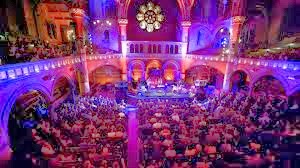
Going to Daylight Music at Union Chapel in Islington for the first time was a where have you been all my life? experience for me. It's a free Saturday lunchtime concert, midday to 2pm, of three mainly contemporary, often folky music acts, where you can get a bacon butty and a cup of tea... allowing your Saturday to fade in gently, in exquisite surroundings. It's a perfect start to the weekend, the best imaginable reason to get out of bed on a Saturday morning and handy for anyone planning a weekend in London as it's right next to Highbury & Islington tube.


For five years this April Daylight Music has been run by Ben Eshmade, 37, (below, right) who it seems to me is remarkable for this reason alone. But also because he might be the only person in the UK who makes a whole living as a music podcaster. The awkward term "content provider"could have been invented for him and Daylight Music is, wonderfully for the rest of us, what he does for fun.

He started out traditionally enough. "I did English and music at the University of Essex and then took a temping job at Thames Water in Colchester," he explained on a leather sofa at the cafe in at Kings Place, one of the music venues where he now works.


"I spent a lot of time getting the Guardian every Monday, applying for every media job I could see and not getting replies. Then I sent off a demo tape to five or six radio stations and got a reply from Essex FM, which I'd only added to the list at the last minute, as an emergency thing. I went back to living with my mum and dad while I did one day a week's work experience there.

"I eventually landed a job in the 'traffic department', which schedules adverts, and ended up doing that for about nine radio stations in the group. It was a very stressful job. But the thing was that when I joined I realised that the email system linked me up with everyone who worked for the same company, which was quite a lot of different stations, including Classic FM.

"I had a bit of luck when someone I know who plays the trombone - I'm a French horn player - went to work at Classic FM and I got a late Friday shift, which involved keeping things ticking over at a time when there was hardly anyone around. There were quite a few months of rushing backwards and forwards between Southend and Colchester in the middle of the night but I ended up getting a full-time job there."

He worked on a late-night show on Classic FM called The Chiller Cabinet, which sounds like a kind of post-club come-down, featuring Balearic beats and involving no talking on his part whatsoever. But it was also a first shot at curating a music show.

"When the Chiller Cabinet ended on Classic FM I was desperate for it to continue," he explained. "So I set up Arctic Circle, with the name referencing the same idea, and started putting on some shows around London. The first one I did was at the Hayward Gallery on the Southbank. There was also one at the Tate called The Lovers, The Dreamers and Me featuring Emily Barker that didn't sell out exactly because there weren't any tickets. But I couldn't get into the room where it was going on."

These days he works for Kings Place and the Barbican as a podcaster, recording interviews with the acts that are scheduled to appear, which are made available through iTunes and Soundcloud, and then using the resulting material for guide articles and programme notes.

"No, I don't know anyone else who does this," he admitted, responding to a question about what he would do when the technology moves on, as it's bound to eventually. "But it's really just audio in a particular format: there'll always be another format. What a podcast is now, among other things, is a way of instantaneously selling a live performance to someone by telling them about it.

'The thing is that I left radio as it was shrinking and shrinking. It seemed as if creativity was frowned upon because it was regarded as expensive. But the beauty of Mixcloud and Soundcloud is that you don't have to tune in at a certain time to hear what you're searching for. You can listen whenever you want."

These days Ben's output includes the spoken word and he admits that he'd love a traditional job as a radio DJ. But what kind of music would he play? When I asked him this question he began to talk about The Sherman Brothers, who wrote much of Disney's early musical material, and Saving Mr Banks, the recent film starring Emma Thompson about the making of Mary Poppins, in which their characters appear.


In fact, although his musical predilections appear strongly to feature things associated with childhood - he also loves Totoro, the fantastical Japanese Ghibli character (above) - I think the variety in his work is as much about necessity and circumstance as anything else: when you're freelance you have to be flexible.

This much is true though. First, he recently produced a charming CD called The Age of Not Believing, whose title references Bedknobs and Broomsticks. "It includes some of everything that's happened in my life up until now," he says, and Emily Barker is on it, singing Hushabye Mountain.

And second, he chooses three bands every week for Daylight Music. So what do they have in common? "There are submissions and recommendations. Occasionally I'll hear about a band and contact them myself but these days a lot of bands contact me online via the Daylight Music site. What I look for when I'm putting together a show is diversity. Oh god. That makes me sound like a bad politician, doesn't it?


"What I mean is that I like choirs and tuba quintets, and once there was a band called Transept who hooked a tree up to a microphone and found a way of playing it. The Transiberian Marching Band and the London Bulgarian Choir both went down a storm, as did those female morris dancers The Belles of London City. Singer songwriters with guitars, on the other hand, find it quite hard to make an impact in Union Chapel, as do guys with laptops, sitting at their laptops. And I tend to avoid acts with agents and managers, though a lot of people who've played at Daylight Music have gone on to do very well. The Leisure Society, for instance. And then there's Nils Frahm, who's playing at the Barbican this year, and Francois and the Atlas Mountains."

Singer songwriters need not despair, though: I've seen some at Daylight and I think what Ben means is that they just have to be extremely good. He also says that he often invites musicians who are subdivisions of other acts he's put on.

"I'm particularly fascinated by the emails that bands send along and how they present themselves. I don't know what anyone else likes, but personally if I'm getting an unsolicited email from a band that wants to play, I'm looking for a short, polite note and a direct link to their music. You wouldn't believe how many people will send a link to their website that has no actual music on it as far as one can see. I particularly like a link to a live performance on YouTube as it's impossible to fake a good live performance. I'm not interested in long rambling histories and mentions of famous people who've said something nice about them. The music is all that matters."

So what's in it for the bands? Do they get paid? "Hmm. I'd be grateful if you could play that down in the article as the emphasis is really on the day as a special event. But we try and make sure that expenses, at least, are covered from the voluntary take on the door." (There is a recommended donation of £3.50 per person and Daylight has been known to pack in as many as 600.) "But over the years what we have been able to offer has evolved into a kind of Daylight Music care package. I try and make sure everyone gets a cup of tea on the way in, we have a team of ten now, including photographers, and we do everything extremely quickly and efficiently.


"There is a professional sound engineer who has two assistants, so what we offer is the opportunity to play what Time Out has described as 'the best venue in London' where we will make you sound as good as you've ever sounded. We have volunteers who will sell your CDs and merchandise for you at the back of the venue and if your performance captures people and you have a reasonably priced CD, you may sell up to 20."

I suppose one of the things about it being in Islington is that you never really know who's going to be in the audience? "Yes. I should say, though, that we've recently had to add a kind of buggy park area because so many people with young families have taken to coming along. And what that means is that we are the first gig that a lot of children ever come to - which is kind of amazing really. But it can also mean that especially quiet, soulful performances can sometimes get a little bit disrupted."

The thing I needed most urgently to ask, though, is why it is so often impossible to get a bacon butty if you arrive after 1pm? The food tables at the back are run by the Margins cafe project, which does a lot of work with the homeless at Union Chapel, including feeding around 200 every Sunday. Some of them return and volunteer, so it's obviously good for getting structure back into people's lives. But, if I get there after all the bacon has run out - which seems to happen quite often - it feels like a barometer of how the rest of my weekend is going to turn out.

Ben laughed, not unkindly.

"Yes. I have on occasion got one of our volunteers to go to the supermarket over the road and buy stuff for Margins. They're characters and they run it in their own unique way: with a lot of enthusiasm but not always getting the quantities right."

There's nothing like bacon as an incentive for getting out of bed earlier.

* If you enjoyed this post and thought it may be useful professionally to you or someone you know, you may also like this, about how Seth Lakeman's music ended up being played on Coast

* If you'd like to receive posts from this blog directly into your Facebook newsfeed, you could *like* its Facebook page and then use the drop-down menu to indicate that it's one of your "interests". This will enhance the possibility that you'll get them. You could also follow me on Twitter at @emma1hartley

Sunday, 21 April 2013

Ben, Josienne, The Young'Uns and Navigator Records

Two bits of news.


Firstly, I understand that the frankly marvellous Josienne Clarke and Ben Walker - for whom the expression "I don't usually like this kind of music but..." could have been coined - have been taken on by Navigator records for the purposes of their new and third album, to be released in July and called Fire and Fortune.


Navigator will be doing marketing, manufacture and distribution. I asked Ben how that came about?

"We met someone from Proper who was interested in distributing the new album. The two ways Proper would distribute it were if we were to self release, or get it released through Navigator... So we gave the CD with an introduction to Navigator, heard they weren't interested, then a couple of days later they called back and asked to meet up..."

What changed their minds then?

"They hadn't listened to it, then they listened to it..."

Yup, that would do it... There's an album launch in July at The Forge in Camden. Get them while they're hot etc.


And the second piece of news is that The Young'Uns, who I saw at Kings Place the other Friday and who made me laugh particularly hard after a long, long week, tell me that they are about to go professional. What does that mean, I asked David Eagle?

"We're all kind of giving up our jobs. Mike is signing up as a supply teacher, Sean will do his story telling and work in schools on a freelance basis, and I'll be doing freelance work too." David does radio work.

As luck would have it, The Young'Uns are also signed to Navigator, so did they have any advice for Josienne and Ben?

"Signing to Navigator is great for profile but you have to sell quite a few albums to make it work for you financially. They should make sure they read the contract and understand what the deal is. But that's great news for them."


What are the practical advantages of being signed to Navigator?

"Exposure, publicity, radio play, media coverage, prestige, complementary groupies..."

But the terms are not especially favourable for the band?

"It depends what you want. If you're as committed and as active as Lucy Ward then I'm sure it worked out brilliantly. But we were part time. It was still a great thing for us though."

It sounds to me as if what The Young'Uns learnt was that they needed to go professional in order to make the most of their Navigator deal.

What's next?

* The Young Uns are on tour at the moment. Check out their website for dates. You can also tweet them here and if you do, it's important to only talk to David, as Mike will then get an annoying ping on his phone every time you send a message but will be unable to do anything about it...

* If you'd like to receive posts from this blog directly into your Facebook newsfeed, you could *like* its Facebook page and then use the drop-down menu to indicate that it's one of your "interests". This will enhance the possibility that you'll get them. You could also follow me on Twitter @emma1hartley

Monday, 8 October 2012

Show me the way to Lau-Land?

Sometimes you can tell from looking at someone's work - or hearing it - that you would like them if you met them. That's what happened when I saw the promotional work Kings Place had done for Lau's upcoming week there: the pictures of the band on the front of and inside its autumn brochure were so curious, so idiosyncratic and so memorable that when I looked at them I knew they'd been shot by someone who takes enormous pleasure in their own work.

Because that kind of enthusiasm is infectious.


So it was great when Nick White, the photographer in question, agreed to a phone interview in the spirit that he was as keen to find out why the pics had turned out the way they had as I was. "It'll be like therapy," he said.

Among my enthusiasms for the pics is that that they're brilliant marketing: Lau's album launch for Race the Loser at Kings Place sold out weeks ago and it's not for a couple of weeks yet. Moreover it's uplifting to see something practical done so well that it transcends the everyday and becomes art, like applying the abstract ideas of physics to the making of a beautiful bridge. Or listening to Lau.

Everyone who's serious about what they do wants to work with other people who care about their craft - there is a nod of recognition, a respect for another's trade that comes with experience. You might not know how the other person does what they do, but you learn to appreciate high quality work when you see it.


Marketing, PR and the other behind-the-scenes stuff of the music industry are what often makes the difference between commercial success and failure and the carelessness with which the folk scene often deals with these matters is a constant source of frustration to me, media creature that I am. I often feel like a distantly related adult watching a teenage girl who doesn't understand that she's beautiful and as a consequence has low self-esteem, throwing her life away. I like this music and I want everyone else to like it too - it's just that most people will never hear it because, metaphorically, it won't brush its hair and leave the house.

However, Nick White's Lau pictures are the most striking piece of folk music marketing I've seen since this.


So how did the idea of Lau-Land emerge?


"I'd done some work for Kings Place before - for a jazz player called Django Bates (above) and the Brodsky Quartet (below)," he said.


"When they asked me to photograph Lau I have to admit that I knew nothing about them, so I listened to the band's music quite a lot to come up with some ideas. Then I spoke to them. The whole idea was that Lau-Land is a special place that they go off to explore - like Victorian explorers. Darwin and the Beagle were going through my head.

"I went to the Red Sea a while ago, to a place called Paradise Island which had a sign with big lettering. I took a picture.


"I really liked the fact that it was taken from the other side, so it was clear that I was actually in Paradise. I sent this picture to the band and I think they took the initiative and had a big sign made saying 'Lau-Land'. I'd like to take the credit for that, but I'm not entirely sure it was my idea. I'd be really interested to hear how they remember it...

"Anyway, originally the idea was to use the sign the other way around, so that they were in Lau-Land. But that was a bit weird and hard to explain, and it got dispensed with early on." Have a squint at the top of that cliff.


"For the picture for the front of the brochure (above) I said 'Let's get lots of stuff in there', things that they might have brought back from Lau-Land. The accordian hands were Martin's idea: he had a toy accordian and said 'I could just have them as my hands'. But there was only one accordian, so I had to shoot him twice and then stick the prints together later. In fact I shot all three of the guys separately and put together a montage in the studio. That picture is actually five different shots - including some extra cliff on the right.

"And we have these little, mysterious things - things from Lau-Land. So there's the arctic fox and the pheasant - and no, it wasn't a live arctic fox. They were both stuffed. Originally I'd wanted to graft the head of the fox on to the pheasant and vice versa. But it would have been too much work and, anyway, I always put more detail into these pictures than people actually notice..."

I asked him some more about the arctic fox. There was a pause.

"You know what? I think I must have been thinking about Philip Pullman's Northern Lights trilogy when I came up with that. One of the characters - Mrs Coulter - she has an arctic fox or a snow leopard as her daemon, doesn't she? There you go... I said this would be like therapy. But you can attach any symbolism you like to any of this. It didn't mean anything specific - like Paul McCartney not wearing any shoes in that Abbey Road Beatles' cover and a myth springing up that it was supposed to be symbolic that he'd died."

White said that most of the snaps had been taken on the windswept Scottish coast back in spring and that the weather had turned nasty.

"There was a lot of walking around with equipment and then the weather suddenly changed and became grim and miserable with driving rain. It was too far to carry all the bits and pieces and too wintry to put the sign up. They didn't enjoy it much - you can tell from the expressions on their faces.

"The band had different attitudes towards the photos. Martin was up for it. Kris just wanted to get it done. And Aidan wanted the whole thing to look more like an indy band shot."

What does an indy band shot look like?

"It's three blokes of a certain age standing around, trying to look interesting. The photographer has to do the rest. Oh - and they're usually dressed in black."

Here's an out-take that didn't make it into the brochure.


"It's not really what I do best," explained White. "There's a whole school of indy band photography that was done most successfully by Anton Corbin, a photographer who worked for NME in the late 80s and early 90s. He was responsible for U2's image round about the time of The Joshua Tree. He also did a lot of shots of Joy Division. But it's not my thing."

So what is your thing?

"My favourite shot is actually one that the band isn't in. It's the map.


"I asked the band to come with some made-up place names, so all the 'places' on that map mean something to at least one of them." I was beginning to see what he meant about "more detail than most people ever notice".

"And that box is something that I really like because I struggled with it and it took a long time.


"The box came from a car boot sale, the plant picture was cut out of The Observer's Book of Cacti and the idea was to make the three of them - there are tiny little images of them there - look like explorers in a flying machine. Their basket was made out of an air mail envelope and the top part came out of an old boiler at my studio - the shell-like metal object. I was thinking about Jules Verne, I think."

I pointed out that there is also a dirigible in the Northern Lights books, belonging to the American, Lee Scoresby. White was delighted.

He said that early on he'd also had an idea of somehow making the three members of Lau look like standing stones because he'd been thinking about The Wicker Man, but that this had been stomped on, on account of it being a "folk cliche" of which the band would have none.

And he mentioned an enthusiasm for Kit Williams's visually stunning 1970s book Masquerade, in which the reader had to piece together a series of pictorial clues with the aim of discovering where a piece of buried treasure shaped like a rabbit lay, somewhere in England. I had a copy of the book as a child and well remember the day I heard that the treasure had been dug up in a park somewhere.

In this spirit he left me with this: "There's a passport stamp on the left-hand side of that box with a date on it. Can you work out what the significance of the date is?" It's November 24, 1859.

Anyone?

* You could explore Lau-Land at Kings Place from Wednesday October 17 until Saturday October 20th, where there will be a series of Lau-related events, including the album launch, which is already sold out.

* Nick White would like to do more work with bands. Here's his website.

* If you'd like to receive posts from this blog directly into your Facebook news feed, you could *like* its Facebook page. Or follow me on Twitter @emma1hartley

Emma Hartley blog logo

24hourlondon logo

Did David Hasselhoff End the Cold War?